Jubilee Bridge, Railway bridge in Hooghly district, India.
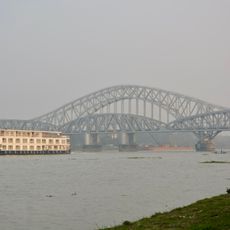
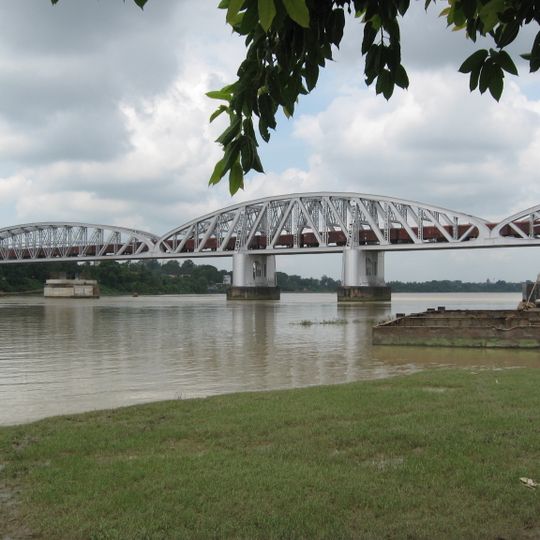
Jubilee Bridge is a 366 m three-span steel cantilever truss railway bridge over the Hooghly River between Naihati and Bandel. It has two 128.10 m side spans and a 109.95 m central span, with white lattice arches resting on dark concrete piers. Rust-brown railway cars remain on its tracks.
Construction began in 1882 and the bridge opened on 16 February 1885, named for the Golden Jubilee of Queen Victoria. It was designed by Sir Bradford Leslie with Alexander Meadows Rendel, and its steel came from Hawks Crawshay of Gateshead and James Goodwin of Motherwell. It was the first permanent crossing over the Hooghly, a river then considered unbridgeable because of difficult foundation conditions.
The name marks Queen Victoria's Golden Jubilee: the bridge opened in 1887, her fiftieth year as monarch. Local Bengali speakers call it জুবিলি ব্রিজ. The steel came from Hawks Crawshay of Gateshead and James Goodwin of Motherwell, and the parts were riveted together on site without nuts or bolts.
The bridge was decommissioned on 17 April 2016, when the last train, the 13141 Teesta Torsha Express, crossed it; traffic now runs on the adjacent Sampreeti Bridge. The deck is closed, so the structure is seen from the banks at Naihati and Bandel rather than crossed. Look for the two 128.10 m side spans and the 109.95 m central cantilever span above the water.
The structure was built entirely through riveting, without using any nuts or bolts in assembly. This handcrafted construction method shows the engineering skill of the late 1800s.
The community of curious travelers
AroundUs brings together thousands of curated places, local tips, and hidden gems, enriched daily by 93,182 contributors worldwide.