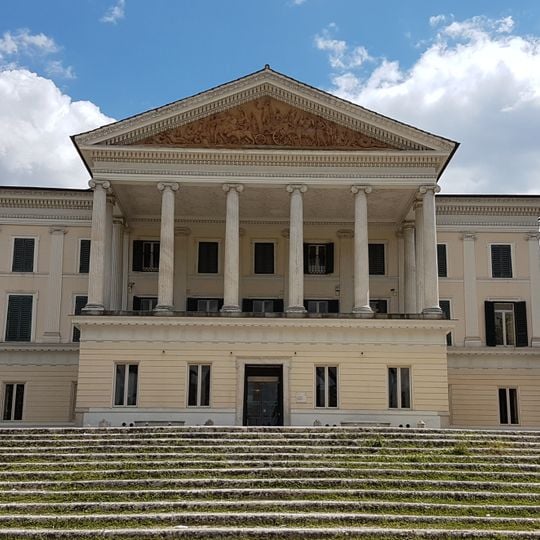
Villa Torlonia, Public park and villa complex in Nomentano, Rome, Italy
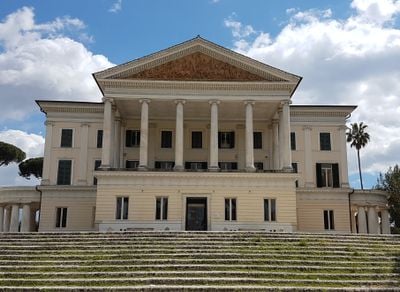
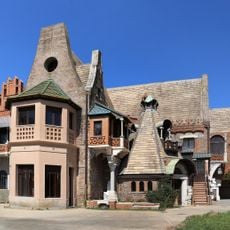
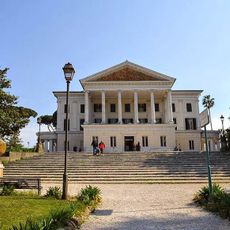
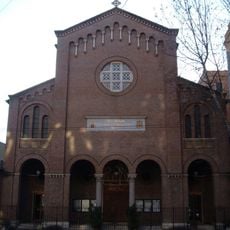
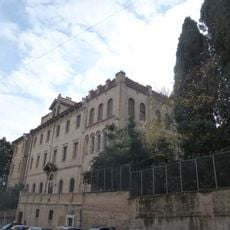
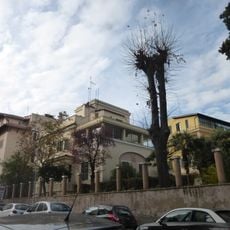
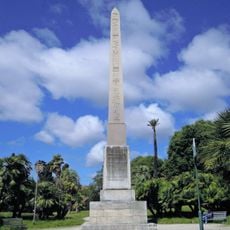
Villa Torlonia is a 19th-century residence with English gardens in Rome's Nomentana district that now serves as a public park. The grounds contain several buildings including the neoclassical Casino Nobile as the main house, the smaller Casino dei Principi, and the Casina delle Civette with its colored glass windows.
Architect Giuseppe Valadier began construction in 1806 for banker Giovanni Torlonia on a former vineyard. His son Alessandro had the grounds expanded until 1842 and added more structures before the property served as Mussolini's residence between 1925 and 1943.
The name comes from the Torlonia banking family who lived on the grounds for over a century and filled it with pavilions and gardens. Today the Casina delle Civette houses a museum of Art Nouveau stained glass windows while the Casino Nobile serves as an exhibition space for the family's sculpture collection.
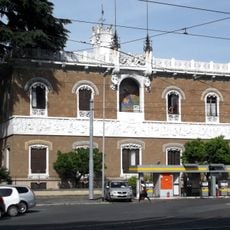
The main entrance is on Via Nomentana, with two more on Via Lazzaro Spallanzani; the park is bounded by Via Siracusa, Via di Villa Massimo and Via Alessandro Torlonia. The monumental propylaea on Via Nomentana, built between 1905 and 1911, house the ticket office and surveillance staff. The Jewish catacomb discovered in 1919 is not open to the public because excavation is disputed under Jewish religious law.
Below the grounds lie air-raid bunkers from World War II built during its use as a state residence. These underground spaces are partly accessible through guided tours and reveal a little-known aspect of the property.
The community of curious travelers
AroundUs brings together thousands of curated places, local tips, and hidden gems, enriched daily by 94,097 contributors worldwide.