Phlegraean Fields, Volcanic caldera in the Metropolitan City of Naples, Italy
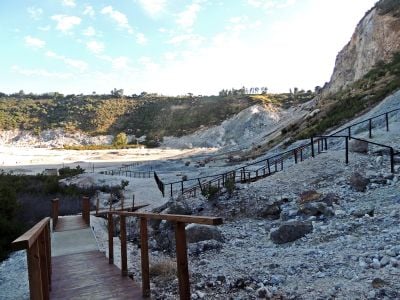
The Phlegraean Fields are a caldera about 15 to 18 km across in the Metropolitan City of Naples, two-thirds of it submerged in the Gulf of Pozzuoli. Its rim runs through the Posillipo and Camaldoli hills, Monte di Cuma and Monte di Procida, and the floor holds low green hills and a long pale strip.
A major eruption roughly 39,280 years ago ejected enormous volumes of magma and shaped the current caldera, with ash reaching large parts of Europe. Smaller eruptions have occurred since then, including one in 1538 that formed Monte Nuovo.
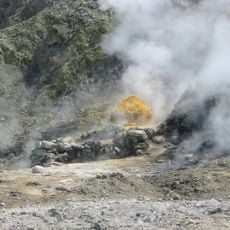
Fumaroles and thermal springs have drawn visitors for centuries who experience natural phenomena in the sulfurous vapors and bubbling mud pools. Many sites throughout the region carry names from ancient mythology, which still recall the long relationship between people and the volcanic landscape.
The area is accessible by car or public transport from Naples, with several craters and thermal springs reachable by walking paths. Visitors should watch for uneven ground and keep a safe distance from craters with active fumarole activity.
The Vesuvius Observatory monitors the region continuously with multiple seismic stations recording ground movements and gas emissions. In September 2023, the area experienced its strongest earthquake in 40 years, measuring 4.2 on the Richter scale.
The community of curious travelers
AroundUs brings together thousands of curated places, local tips, and hidden gems, enriched daily by 94,466 contributors worldwide.