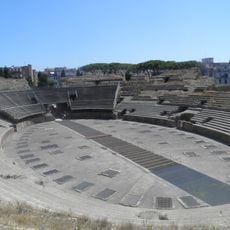
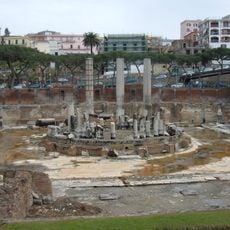
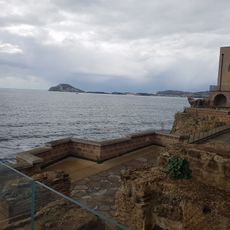
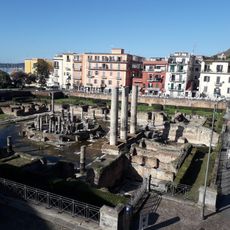
Anfiteatro minore, Roman amphitheatre in Pozzuoli, Italy.
The Anfiteatro minore in Pozzuoli is a Roman amphitheatre of Augustan or pre-Augustan date, with ellipse axes of about 130 and 95 metres. What survives is roughly ten arches in opus incertum, which supported the curve of the cavea. Built on the Pompeian model, it had no underground chambers for venationes.
The Anfiteatro minore is the older of Pozzuoli's two Roman arenas, built in the Augustan or pre-Augustan period with ellipse axes of about 130 and 95 metres. It lacked the underground chambers used for venationes, so under the Flavians the larger amphitheatre was built for gladiatorial games. It was identified during construction of the direct Rome-Naples railway, which cut through it centrally and damaged it badly.
The name distinguishes it from Pozzuoli's larger Flavian amphitheatre, built when this one proved inadequate for gladiatorial games. The Odemira glass vase shows two Puteolan amphitheatres, the lower marked with a whip for venationes and the upper with a palm for gladiator combat. Suetonius records that overcrowding once kept a senator from entering, prompting Augustus to set new access rules.
The ruins lie in the built-up area of Pozzuoli, crossed centrally by the Rome-Naples railway line, so the surviving arches are seen from outside rather than entered. Look for the roughly ten arches in opus incertum that once supported the curve of the cavea. There is no organised visiting infrastructure on site.
The Odemira glass vase, a Roman artefact, depicts two amphitheatres of Pozzuoli: the lower one marked with a whip, the upper with a palm. Scholars read the whip as a sign for venationes, the palm for gladiator combat, which fits the smaller arena's lack of underground service areas.
The community of curious travelers
AroundUs brings together thousands of curated places, local tips, and hidden gems, enriched daily by 94,091 contributors worldwide.