Emperor Claudius' sunken nymphaeum, Roman nymphaeum in the submerged park of Baia, Campania, Italy
The Ninfeo di Punta Epitaffio is a Roman nymphaeum built under Claudius (41–54 AD), lying about 7 metres below sea level in the submerged park of Baia. Its rectangular hall, roughly 18 by 10 metres, ends in a marble-clad semicircular apse with a central basin; four niches on the side walls held statues, and a channel ran along the perimeter.
The structure was built in the middle of the first century during a Roman emperor's reign. It later sank due to natural changes of the coastline in this volcanic region.
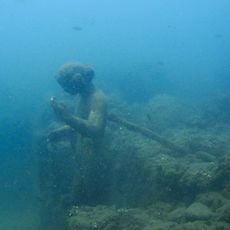
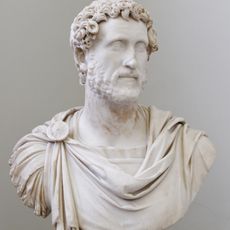
The hall's decoration recreated a grotto: artificial rock lined the apse, the side niches and the entrance arch, while water ran along a channel at the walls and filled the central basin. The sculptural group in the apse showed Odysseus offering a cup of wine to Polyphemus, with a companion carrying a wineskin; the Cyclops himself is lost. Four of the eight side statues survive, among them two young Dionysus figures suited to a banqueting room, Antonia Minor as Augusta holding a winged child, and a girl whose hairstyle recalls portraits of the young Nero.
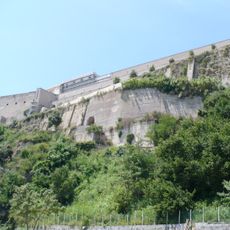
The nymphaeum lies about 7 metres below sea level in the Parco sommerso di Baia, in the Gulf of Pozzuoli. The hall, roughly 18 by 10 metres, is reached by guided dives; the original marbles are in the Museo archeologico dei Campi Flegrei in the Aragonese castle of Baia, and copies stand in the water.
The marble sculptures found in 1969 were moved to the Museo archeologico dei Campi Flegrei in the Aragonese castle of Baia, and copies were later placed back in their original positions on the seabed. The headless Cyclops was never recovered; only Odysseus offering the cup and a companion carrying a wineskin survive.
The community of curious travelers
AroundUs brings together thousands of curated places, local tips, and hidden gems, enriched daily by 93,421 contributors worldwide.