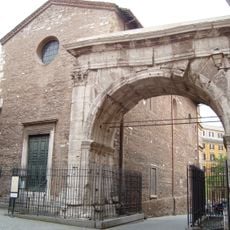
Arch of Gallienus, Triumphal arch near Esquiline Hill, Rome, Italy.
The Arch of Gallienus is the ancient Porta Esquilina, a gateway of the Servian Wall rebuilt in monumental form under Augustus, where the Via Labicana and Via Tiburtina began. Its single surviving travertine arch stands 8.80 m high, 7.30 m wide and 3.50 m deep, flanked by pilasters with Corinthian capitals and topped by a 2 m entablature bearing the 262 inscription. It now rests against the church of San Vito on Via San Vito, the ancient Clivus Suburanus.
The structure originally formed part of the Servian Wall and was rededicated in 262 CE to Emperor Gallienus and his wife Salonina. This repurposing occurred during a turbulent period when the empire faced severe political and military challenges.
The surviving inscription on the architrave names Gallienus as "clementissimo principi" and his wife Salonina as "sanctissimae Augustae", followed by the dedicator Aurelius Victor, a Roman knight. The first part of the text was cut on marble slabs fixed above; the holes for their metal fixings are still visible.
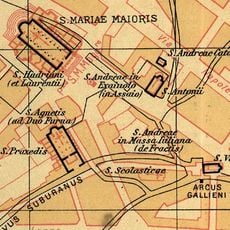
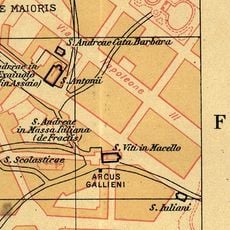
The arch stands in Via San Vito, the ancient Clivus Suburanus, beside the church of San Vito. The street continues as Via S. Martino ai Monti along the line of the ancient Argiletum toward the Roman Forum. The monument is at street level and can be viewed from the pavement at any time.
The arch originally had smaller side openings for pedestrians that were removed during 15th century renovations. Historical drawings from that era show these lost passages and reveal how the monument looked before these changes.
The community of curious travelers
AroundUs brings together thousands of curated places, local tips, and hidden gems, enriched daily by 94,062 contributors worldwide.