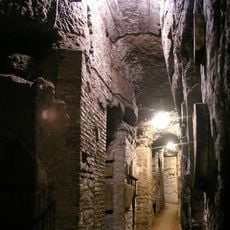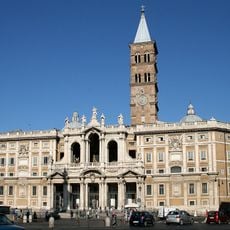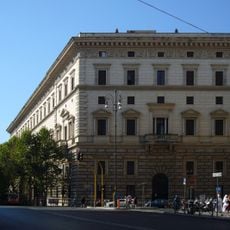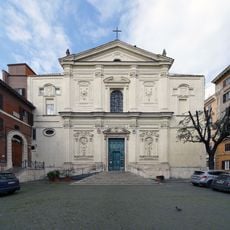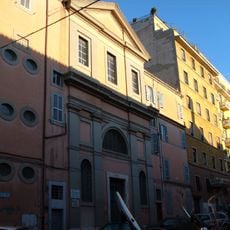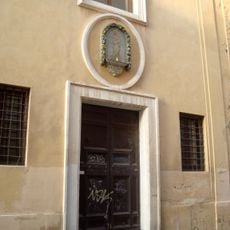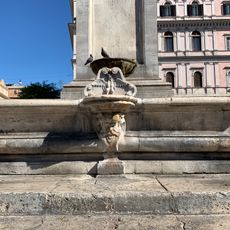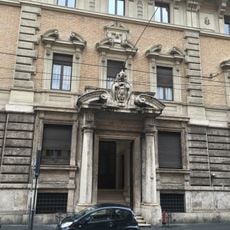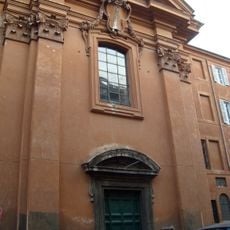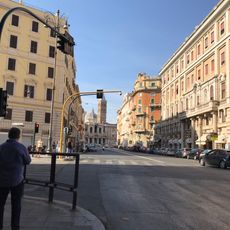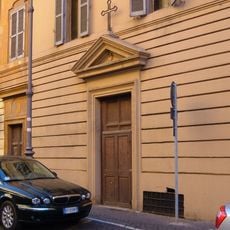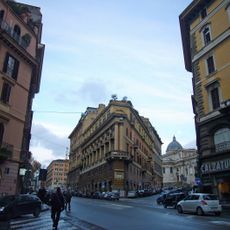
Santa Prassede, Minor basilica in Monti district, Rome, Italy.
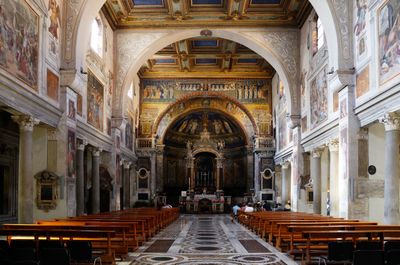
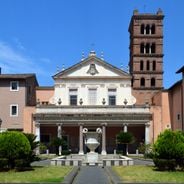
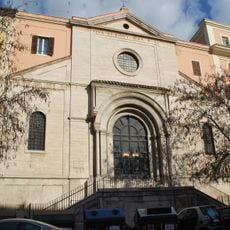
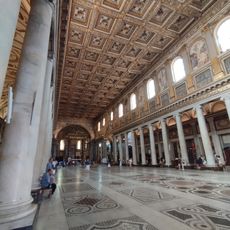
Santa Prassede is a minor basilica on Via di Santa Prassede in Rome's Monti district, its facade hidden inside a courtyard and reached by a descending staircase. The interior follows the plan of old St. Peter's: a central nave and two side aisles divided by columns, a transept and an apse. A flat coffered ceiling painted blue with gilded ornaments covers the nave, and the floor is laid with patterned stone in circular and geometric designs.
A titulus Praxedis is attested here by a plaque of 491, and a church stood on the site by at least the 5th century. Pope Hadrian I rebuilt the decaying titulus around 780 to hold the relics of Saints Praxedes and Pudentiana. Pope Paschal I replaced that building with the present basilica in 817, and in 1198 Innocent III gave it to the Vallombrosan Benedictines, who still serve it.
The apse mosaic, made under Paschal I in the 9th century, shows Christ flanked by Peter and Paul, who present Praxedes and Pudentiana; on the left Paschal offers a model of the church, his square halo marking him as still living. The apsidal arch carries twelve figures per side holding victory wreaths, with the four Gospel symbols around a lamb.
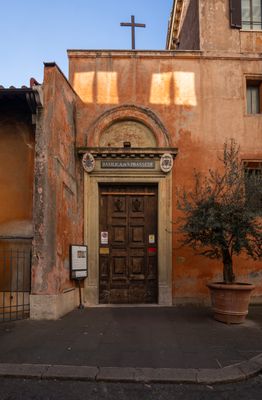
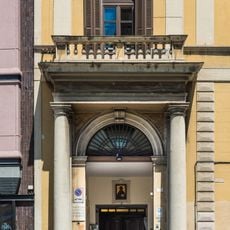
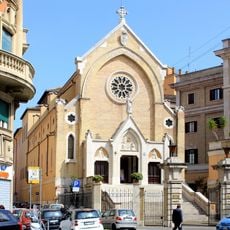
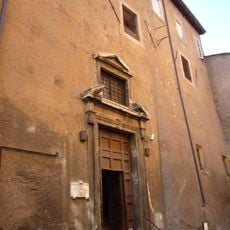
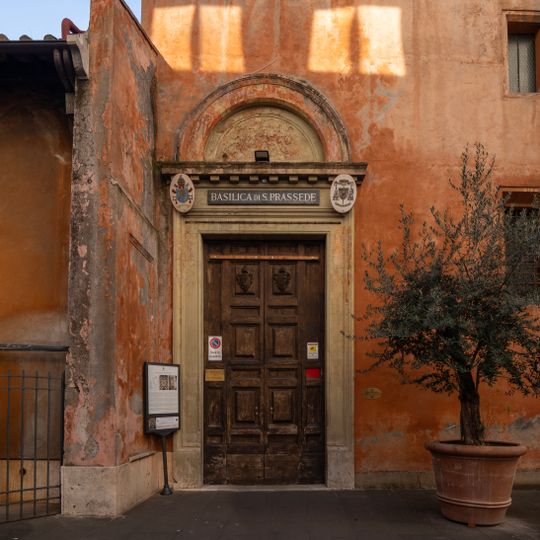
The usual entrance is the side door on Via di Santa Prassede; the main portal on Via San Martino ai Monti is rarely used and reached by a long descending staircase. The facade sits inside a courtyard and cannot be seen from the street. The Column of the Flagellation is in the Chapel of Saint Zeno, to the right of the apse.
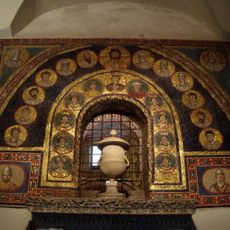
The porphyry disk in the floor, near the chapel of Saint Zeno, is said to mark the well where Praxedes hid the bodies and blood of martyrs. The chapel itself was built by Pope Paschal I as a burial place for his mother Theodora, whose portrait appears in its mosaics with a square halo, the sign of a living person.
The community of curious travelers
AroundUs brings together thousands of curated places, local tips, and hidden gems, enriched daily by 94,672 contributors worldwide.