San Michele in Borgo, Romanesque church in Pisa, Italy
San Michele in Borgo is a church on Borgo Stretto in Pisa. Its facade, spared in World War II bombing, has a 13th-century lower section and a 14th-century upper part with three orders of Gothic loggias and a tabernacle of the Madonna and Child by Lupo di Francesco (a copy; the original is in the Museo di San Matteo). The interior has three naves and eight bays, with a raised area over an 11th-12th-century crypt.
The structure was built atop the remains of an ancient temple and became an important monastery during the Middle Ages. The site underwent several changes as different religious orders occupied it over the centuries.
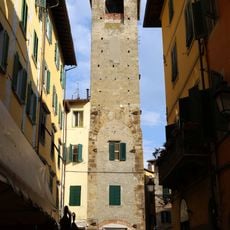
The church stands on Borgo Stretto, Pisa's main medieval shopping street, and its name refers to this borgo rather than to a saint's shrine. On the facade, seventeenth-century inscriptions record the election of the rector of the University of Pisa, a reminder of the church's link with the city's studium. The marble Crucifix attributed to Nino Pisano stands at the left altar.
The church stands on Borgo Stretto, Pisa's main shopping street, a short walk north of the Arno. The 11th-12th century crypt lies under the presbytery and is reached through an opening behind the apse, but it has been flooded for years and cannot be visited. The cloister and Benedictine monastery that once adjoined the church were destroyed or demolished; the Mattonaia complex by architect Massimo Carmassi, begun in 1986, occupies the site.
The crypt beneath the presbytery keeps 11th–12th-century cross vaults and Roman capitals, painted with imaginary animals: a griffin, a lion, an eagle and a winged sea horse. Alessandro da Morrona first described it in detail in 1791 in his Pisa Illustrata. It opens from a doorway behind the apse but has been flooded for years.
The community of curious travelers
AroundUs brings together thousands of curated places, local tips, and hidden gems, enriched daily by 94,106 contributors worldwide.