Torre del Campano, Medieval tower house in Pisa, Italy
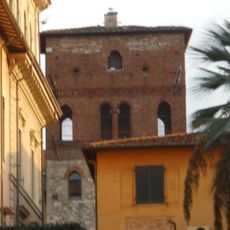
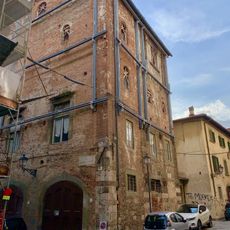
The Torre del Campano is a tall, narrow medieval tower house in Pisa, rising five floors on a rectangular plan. Its masonry shows several building phases: a large relieving arch spans the lower two levels, while the upper part is continuous walling in a lighter grey stone, perhaps verrucana, with blocked single-light windows, some replaced by modern ones. Putlog holes and projecting corbels on the outer walls point to former wooden balconies.
The tower was originally called dei Casciai or Caciaioli. In December 1785 Grand Duke Pietro Leopoldo bought it and had a new bell cast by Alessandro Tognozzi so it would mark study hours for University of Pisa students from 7:30 a.m.; the verse Audite disciplinam et estote sapientes was engraved on the bell. Its masonry shows several building phases.
The tower takes its name from the bell cast in 1785 by Alessandro Tognozzi for the University of Pisa, which rang study hours from 7:30 in the morning. The verse Audite disciplinam et estote sapientes was engraved on it. Before that, the university bell hung in a tower on the Lungarno called dei Vinai.
The tower stands in Pisa's historic centre, near the university it once served, and is a tower house rather than a climbable monument; the bell cell is not open to visitors. Look up from street level at the five storeys, the large relieving arch over the lower two floors and the blocked single-light windows. The exterior walls show putlog holes and projecting corbels that once carried wooden balconies.
The tower was built in several phases, and the masonry still shows this: the lower two floors have a large relieving arch, while the upper part is continuous walling in a lighter grey stone, perhaps verrucana. Corbels and putlog holes on the outer walls suggest wooden balconies once extended the narrow living space.
The community of curious travelers
AroundUs brings together thousands of curated places, local tips, and hidden gems, enriched daily by 94,053 contributors worldwide.