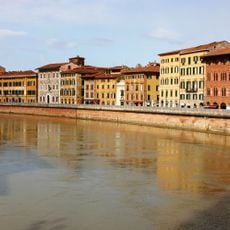
Palazzo della Sapienza, Renaissance palace in Pisa, Italy
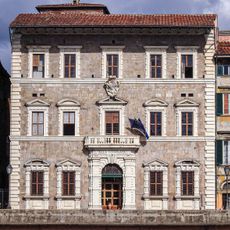
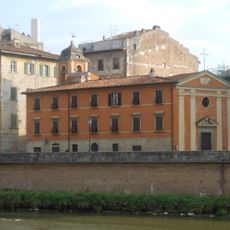
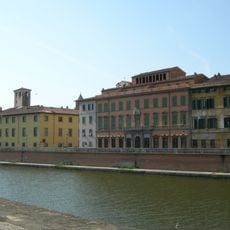
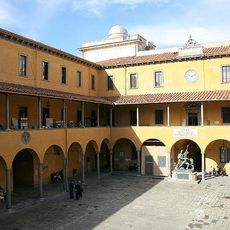
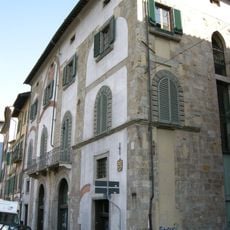
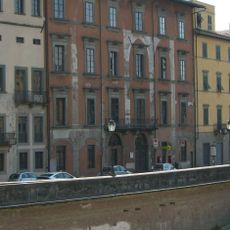
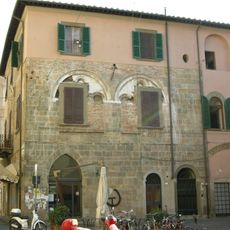
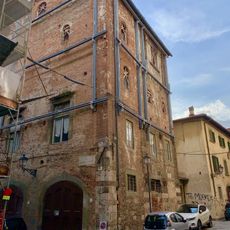
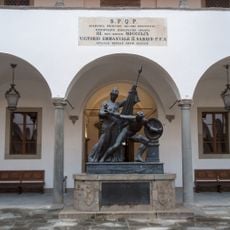
Palazzo della Sapienza is a three-story Renaissance palace in Pisa that spans an entire block near Lungarno Pacinotti. The building features a symmetrical facade opening onto a white internal courtyard from the 16th century, surrounded by arcade-supported galleries.
The palace was founded in the Renaissance and substantially rebuilt in the 20th century. The academic year 1922-1923 opened with a ceremony in the new Aula Magna, ending about fifteen years of construction work that reshaped the old building. Between roughly 1985 and 1995, building machinery including pneumatic hammers disturbed lessons and library readers.
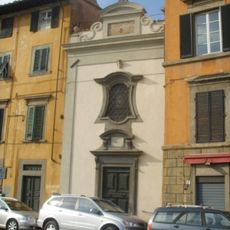
The palace takes its name from the Sapienza, the medieval term for a university, and its porticoes are crossed daily by students, lecturers and passers-by. The Medici coat of arms at via della Sapienza 4 was carved by Pierino da Vinci, possibly with the sculptor Tribolo. The Aula Magna Nuova, built in the early 1900s, still hosts ceremonies.
The palace occupies the whole block between via Curtatone e Montanara, the vicoli della Sapienza and dell'Ulivo, and via Tanucci, which ends at Piazza Dante. Its porticoes are open thoroughfares crossed day and night by students and residents. Ground-floor rooms get little daylight, so artificial lighting is used during the day. The Aula Magna Nuova, built in the early 1900s, is reached by a wide staircase and now has a lift.
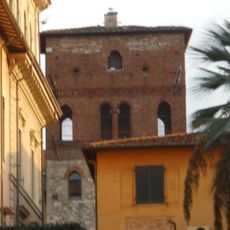
The Medici coat of arms at via della Sapienza 4 was made by Pierino da Vinci, possibly with the sculptor Tribolo. Look up at the southwest corner: the dome of the observatory breaks the symmetry of the roofline, set against the small central clock tower.
The community of curious travelers
AroundUs brings together thousands of curated places, local tips, and hidden gems, enriched daily by 93,136 contributors worldwide.