Pieve di Brancoli, Romanesque parish church in Lucca, Italy.
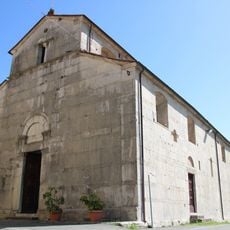
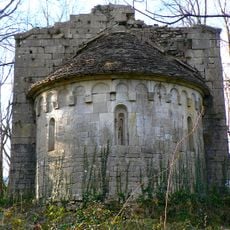
The Pieve di Brancoli is a Romanesque parish church standing on a hillside with three naves divided by columns and pillars. The building features a semicircular apse and a bell tower topped with crenellations.
A church dependent on the pieve of Sesto is documented from 772; the first record of it as an independent pieve dates to 1092. In the second half of the 11th century, under Bishop Anselmo da Baggio (later Pope Alexander II) and with investments by Matilda of Canossa, the present building was begun. It is one of the most representative examples of the architectural language developed between the 11th and 12th centuries.
The 1194 ambo is signed by the master Guidetto, rests on Corinthian columns and two carved lions, and stands near a 12th-century octagonal font with a carved fruit at each corner. The glazed terracotta of Saint George and the dragon is attributed to Andrea della Robbia, while the painted cross above the altar is of the Lucchese school.
The church sits about 10 kilometers (6 miles) from Lucca's center on a hillside reached by a winding country road. Tours can be arranged by calling ahead to book a visit.
The side portal's architrave carries an 11th-century bas-relief of a naked figure with large raised arms and hands, probably carved for apotropaic, protective purposes. The church also lost its signed 11th-century holy water stoup, bearing the sculptor Raitus's name, when it was stolen in June 2000.
The community of curious travelers
AroundUs brings together thousands of curated places, local tips, and hidden gems, enriched daily by 94,244 contributors worldwide.