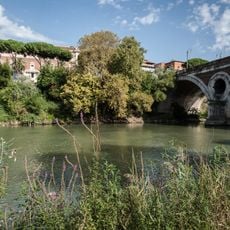
Ponte Giacomo Matteotti, Stone bridge in northern Rome, Italy.
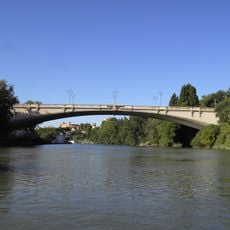
The Ponte Giacomo Matteotti is a river crossing over the Tiber in northern Rome featuring three brick arches that support both vehicles and pedestrians. The structure spans approximately 138 meters and connects the northern Lungotevere with the southern area in a straightforward passage.
Planned in Rome's 1909 regulatory plan as Ponte delle Milizie, the bridge was designed by municipal architect Augusto Antonelli, whose winning entry carried the motto "Aurea Simplicitas". The first stone was laid on 1 November 1924 in the presence of Benito Mussolini and ministers Luigi Federzoni and Gino Sarrocchi; it opened on 21 April 1929, the Natale di Roma, as Ponte del Littorio. In 1945 the city renamed it after socialist deputy Giacomo Matteotti, kidnapped and killed near the bridge in 1924.
The bridge was renamed Ponte Giacomo Matteotti in 1945 by Rome's municipal council, honouring the socialist deputy kidnapped and killed in 1924 by a Fascist squad near the bridge. Its earlier name, Ponte del Littorio, was given at its 1929 inauguration on the Natale di Roma.
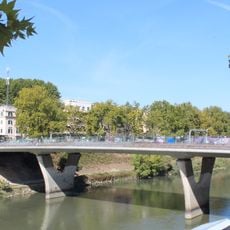
The bridge carries four lanes on three carriageways, with two side pavements; two lanes hold the tracks of Rome's tram line 19, which crosses it. Pedestrians walk the raised pavements beside the traffic, and the bridge links Lungotevere Arnaldo da Brescia with Piazza delle Cinque Giornate.
On both sides of the central arch, sculptor Oreste Giordano Michetti carved an eagle with spread wings flanked by two fasces. Above the two piers, circular openings echo the "occhialone" water-gauge of Ponte Sisto. The bridge was first called Ponte delle Milizie, after the avenue it aligns with.
The community of curious travelers
AroundUs brings together thousands of curated places, local tips, and hidden gems, enriched daily by 93,359 contributors worldwide.