Sant'Andrea di Borzone, Medieval church in Borzonasca, Italy.
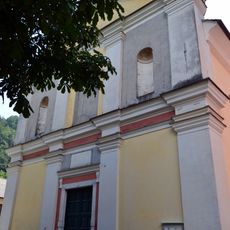
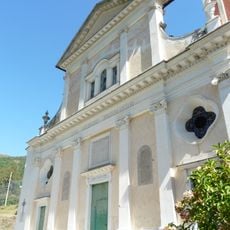
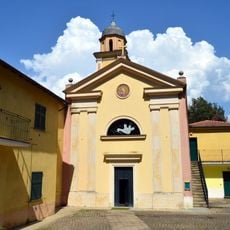
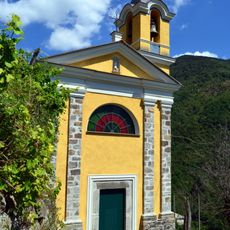
Sant'Andrea di Borzone is an abbey complex standing alone at 335 m on a slope about three kilometres from the centre of Borzonasca. It comprises the church, sacristy, cloister, a canonica and a farmhouse; the bell tower is a tower in bugnato blocks of the early 13th century, given a bell chamber in 1310. The church has a single nave of three bays with a main altar from the first half of the 18th century and three side altars.
According to tradition, the Lombard king Liutprand founded the church and monastery between 712 and 714 on the site of a declining Byzantine fortress. A document of 972 records the complex being entrusted to the Benedictines of San Colombano di Bobbio, who administered the Sturla valley until the year 1000. In 1184 the Fieschi counts of Lavagna had the church elevated to an abbey by the archbishop of Genoa Ugone della Volta; it became a parish commendam in 1185 and remained one until 1847.
The abbey church is the seat of the parish of Sant'Andrea in the vicariate of Sturla and Graveglia, Diocese of Chiavari, which has managed the complex since 1910. In September 2014 the diocese named Father Attilio Fabris the abbey's first diocesan monk, after the last Benedictines left in 1536. Above the main altar hangs a copy of the polyptych of Saint Andrew, attributed to Giovanni da Barbagelata or Carlo Braccesco; the original has been at the diocesan museum of Chiavari since 2003.
The abbey stands about three kilometres from Borzonasca's built-up centre, at 335 m above sea level in a solitary spot, so it is reached by a country road rather than on foot through the village. The church is the seat of the parish of the vicariate of Sturla and Graveglia, diocese of Chiavari, so opening depends on parish use.
The polyptych of Saint Andrew, attributed to Giovanni da Barbagelata or Carlo Braccesco, hung in the church until 2003, when it moved to the diocesan museum in Chiavari; a copy now stands above the main altar. Its panels show the Crucifixion with the Virgin and John the Baptist, Saints Bernard and Apollonia, Euphemianus and Anthony Abbot, and below, Andrew, Peter, Sebastian, Lawrence and Catherine.
The community of curious travelers
AroundUs brings together thousands of curated places, local tips, and hidden gems, enriched daily by 94,027 contributors worldwide.