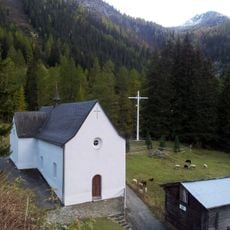
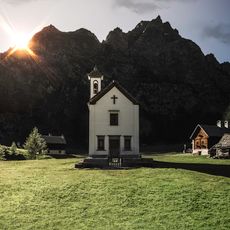
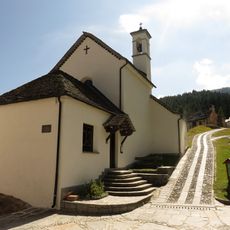
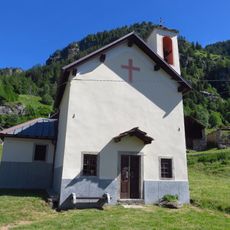
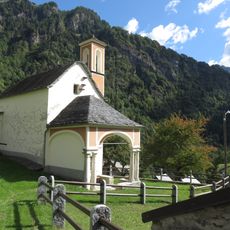
Alpe Devero, Mountain pasture in Baceno, Italy.
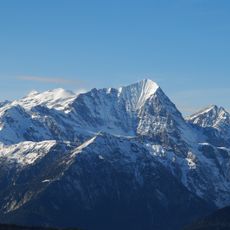
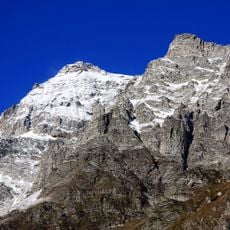
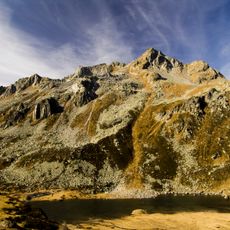
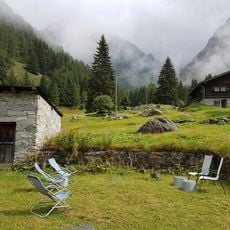
Alpe Devero is a hamlet of Baceno at 1,635 m in the Valle Devero, a broad grassy plain ringed by larch woods and the peaks Monte Cervandone, Punta della Rossa, Pizzo Cornera and Pizzo Fizzi. Its houses are baite with roofs of stone slabs (piode); two low stone buildings with shallow pitched roofs stand on rising ground above the meadow. Just northeast of the village and Crampiolo lies the artificial Lago Codelago.
A bronze dagger of the "Veruno" type, dated 1600-1300 BC, was found in 1966 in a quartz-crystal fissure near the Bocchetta d'Arbola at 2,510 m, showing the pass was already used in the Bronze Age. For centuries the route linking Baceno, Alpe Devero and the Arbola Pass (2,409 m) carried grain and wine toward Valais and brought back butter, cheese, wool and cattle.
The stone buildings with piode (stone-slab) roofs visible in the village are examples of local alpine architecture, protected since the Landscape Plan halted unregulated building. The Alpe Devero remains a working pasture for cattle, and the area is known for Bettelmatt cheese. The name Devero also labels the artificial Lake Codelago on the valley floor.
Private vehicles cannot enter or circulate in the valley; paid car parks are set up before the entrance. The village is reached from Goglio, a hamlet of Baceno, by a municipal road about 7 km long. Experienced hikers can continue from Alpe Devero toward Binn in Switzerland via the Combi and Lanza bivouac at 2,429 m in Val Buscagna.
The bronze dagger of the "Veruno" type found in 1966 near the Bocchetta d'Arbola, at 2,510 m, in a quartz crystal fissure, dates to the transition between the early and middle Bronze Age (1600–1300 BC). It shows the pass above Alpe Devero was already crossed in prehistoric times.
The community of curious travelers
AroundUs brings together thousands of curated places, local tips, and hidden gems, enriched daily by 92,633 contributors worldwide.