Notarchirico archaeological area, Archaeological site in Venosa, Italy.
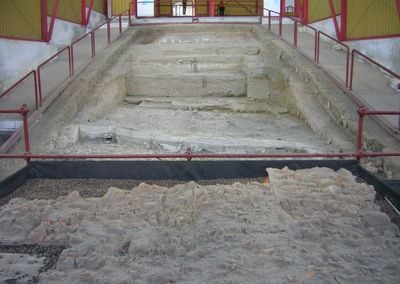
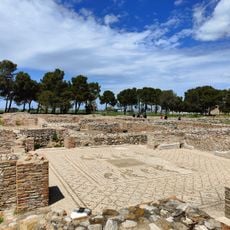
The Notarchirico archaeological area is an open-air Palaeolithic site about 9 km from Venosa, in the Venosa basin beneath Monte Vulture. Excavations since 1980 exposed a 7 m sequence of twelve occupation layers, separated by sterile bands, with handaxes, animal bones and a butchered elephant. There are no houses or buildings: the finds are displayed in the Museo Archeologico Nazionale di Venosa.
The site was discovered in 1979 and excavated from 1980 to 1985; since 2016 a team from the Muséum national d'histoire naturelle in Paris has resumed digs. Twelve layers, 7 m thick in all, span roughly 650,000 to 450,000 years ago, with sterile bands of 10 to 100 cm between them. A hominin femur found in 1985, VN-H1, dates to between 661,000 and 614,000 years ago.
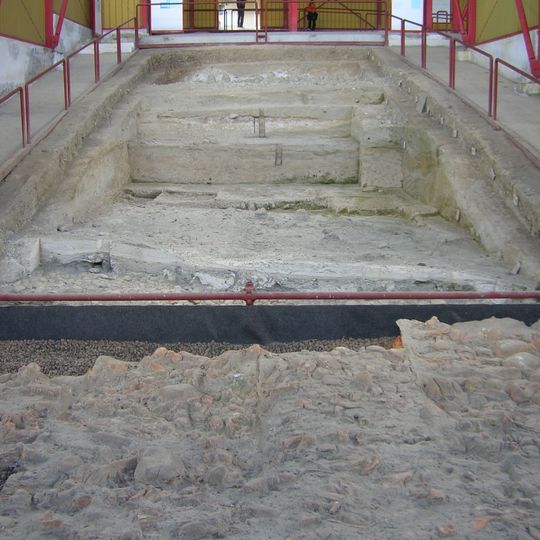
The name Notarchirico comes from the locality near Venosa where the site lies. The finds, including handaxes among the oldest in Europe and bones of elephants, bison and rhinoceroses, are mostly kept at the Museo Archeologico Nazionale di Venosa, so the excavated area itself shows the strata rather than the objects.
The open-air site lies about 9 km from Venosa in the Venosa basin, a former river valley facing Monte Vulture. Excavation campaigns have run since 1980 and continue under the Muséum national d'histoire naturelle in Paris, so some sectors may be fenced off. The excavated finds, including the VN-H1 femur, are displayed at the Museo archeologico nazionale di Venosa in town.
The femur fragment VN-H1, found in 1985 beside the tools, belongs to a Homo heidelbergensis adolescent and is the oldest human remain in southern Italy, dated to between 661,000 and 614,000 years ago. Most finds are kept in the National Archaeological Museum of Venosa.
The community of curious travelers
AroundUs brings together thousands of curated places, local tips, and hidden gems, enriched daily by 93,484 contributors worldwide.