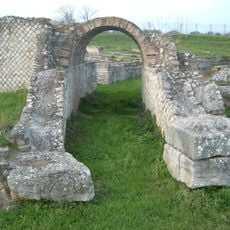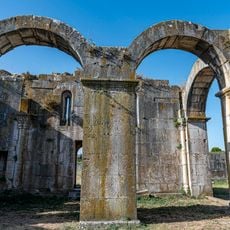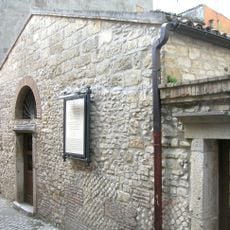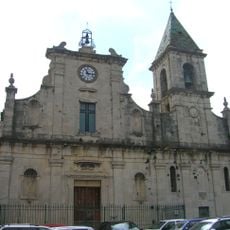
Jewish catacombs of Venosa, Jewish catacombs in Venosa, Italy
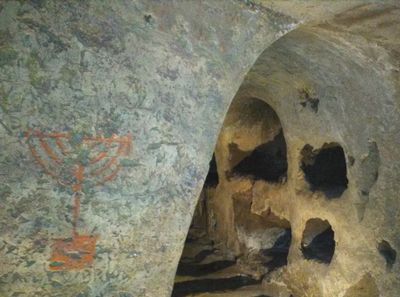
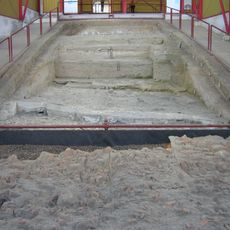
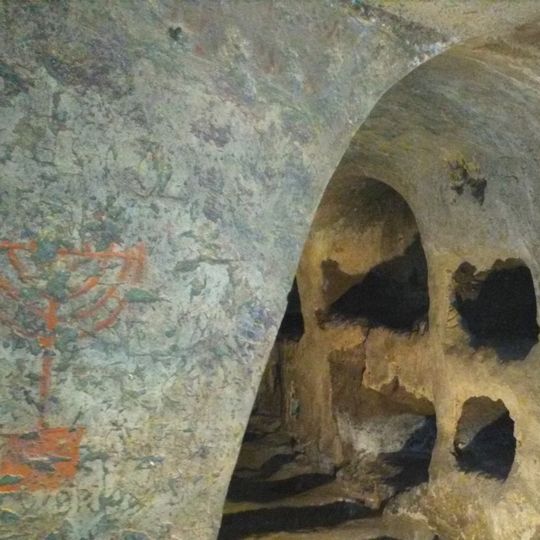
The Jewish catacombs of Venosa are carved into the tufa of Maddalena Hill outside the town, with two parallel tunnels linked by short passages. Loculi for burials are cut into the walls and floor, and the tombs carry painted and carved Jewish iconography, including the menorah, alongside Greek, Latin and Hebrew epitaphs.
The site was discovered in 1853 and dates to the 4th through 6th centuries CE. One inscription provides a precise date of 521 CE, which anchors our understanding of when these burials took place.
Most names on the epitaphs are Greek or Latin rather than Hebrew, showing how far Venosa's Jews had adopted local naming; only a minority carry Hebrew etymology. The earliest texts are in Koine Greek, with Latin appearing in the newer, deeper sections. One inscription, possibly 5th century, commemorates Faustina, daughter of Faustinus, who died aged 14 years and 5 months, eulogized by two emissaries (apostoli) and two rabbis (rebbites).
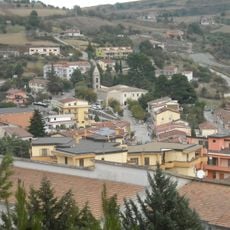
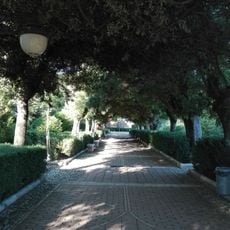
The catacombs lie on Maddalena Hill on the outskirts of Venosa, in the Province of Potenza, and are reached by car. Access is only permitted with supervision, so a guided visit must be arranged in advance through the Archaeology Office of Basilicata. The tunnels are carved into the hillside and the ground is uneven.
The catacombs contain around seventy inscriptions, holding more Hebrew text than the Jewish catacombs of Rome. Religious symbols such as the menorah are carved into the stone, testifying to the importance of this burial site for the local Jewish community.
The community of curious travelers
AroundUs brings together thousands of curated places, local tips, and hidden gems, enriched daily by 94,461 contributors worldwide.