Augusta Bagiennorum, Archaeological site in Bene Vagienna, Italy.
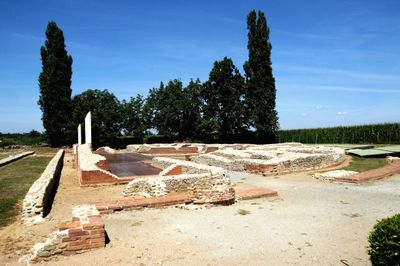
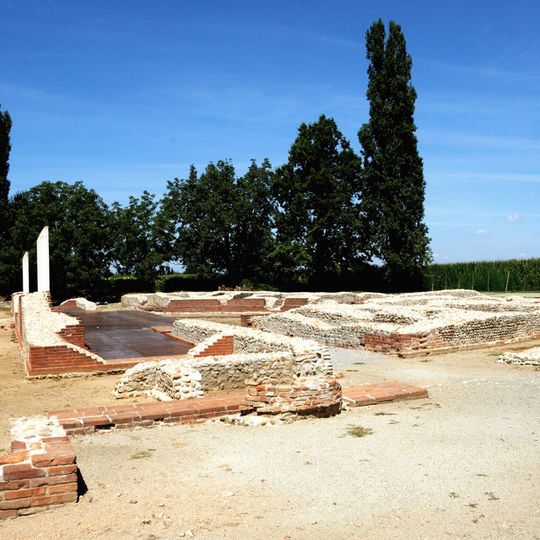
Augusta Bagiennorum is a Roman city in the Roncaglia plain near Bene Vagienna, founded in the late 1st century BC. Its excavated forum has porticoes with plastered shops, a three-aisled civil basilica and a temple on a high podium; southeast of it lie a theatre with a quadriporticus and a small three-apsed early Christian basilica. Outside the walls, the unexcavated amphitheatre has a major axis of about 120 m.
Augusta Bagiennorum was the chief town of the Ligurian Bagienni, conquered by Rome around the mid-2nd century BC. The Roman foundation, probably from the age of Augustus at the end of the 1st century BC, was not built over an earlier settlement and was laid out on a systematic plan. Bene Vagienna marked its bimillennium in 2000, fixing the official founding by convention at the start of the 1st century AD.
The excavated remains display the typical Roman town grid with perpendicular streets and a central forum where residents gathered for public affairs. The outlines of bathhouses and temples reveal how religious practice and social life were woven into the daily rhythm of this ancient community.
The site sits roughly 56 kilometers south of Turin and is easily reachable by car or public transport from the city. The ruins are located outdoors, so weather-appropriate clothing and sun protection are recommended, especially if you plan to spend time exploring the whole area.
The amphitheatre lies outside the city walls and has never been fully excavated; a partial survey identified its outer perimeter wall, radial walls, U-shaped buttresses with traces of stairs, and a vaulted corridor leading straight into the arena. Its opus incertum masonry with brick courses dates it to the first half of the 1st century AD.
The community of curious travelers
AroundUs brings together thousands of curated places, local tips, and hidden gems, enriched daily by 92,631 contributors worldwide.