Chiesa di Santa Maria Assunta, Baroque church in Bene Vagienna, Italy
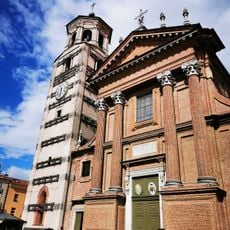
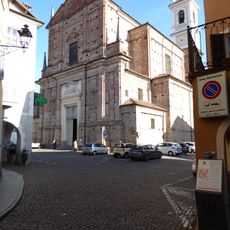
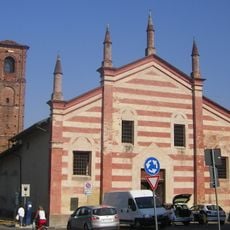
The church of Santa Maria Assunta has a single nave with deep side chapels framed by round arches, walls marked by composite pilasters carrying a projecting cornice, and a semicircular apse behind the raised presbytery. Its southeast facade is divided into two registers by a string course, with three portals and two windows below, a serliana and volutes above, and a triangular pediment on top.
First mentioned in 901, this church was redesigned by architect Giovenale Boetto and completed in 1659. The transition from its medieval origins to this Baroque rebuilding marks a major shift in how the community reconceived this religious space.
The church preserves frescoes by Luigi Morgari, a Piedmontese painter active between the late 19th and early 20th centuries. The source does not give the exact years of these works, so they should not be dated to 1857–1912. Look for them in the single nave and the semicircular apse.
The church faces southeast, with its main entrance on the facade; the bell tower stands attached to the building. Bene Vagienna's historic centre is compact, so the church is reached on foot from the town's streets. The interior has a single nave with side chapels and a presbytery raised by several steps.
The square bell tower has a single opening on each side of its bell chamber and is topped by a spire on a circular base, not an octagonal Gothic one. The facade, rebuilt between the 19th and 20th centuries, is crowned by a triangular pediment and flanked by two volutes.
The community of curious travelers
AroundUs brings together thousands of curated places, local tips, and hidden gems, enriched daily by 94,357 contributors worldwide.