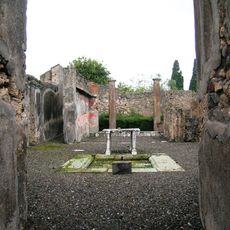
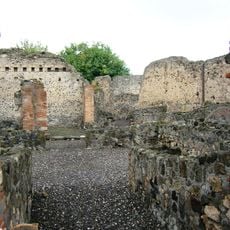
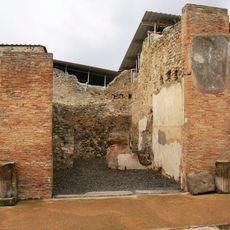
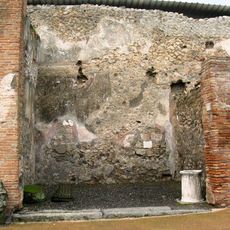
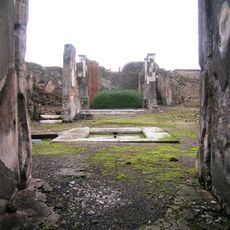
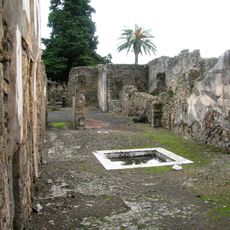
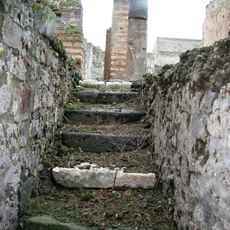
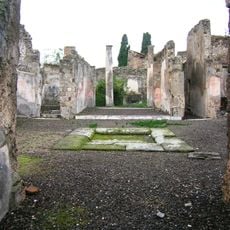
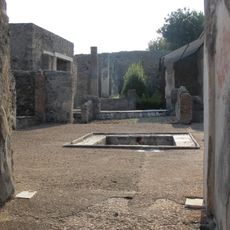
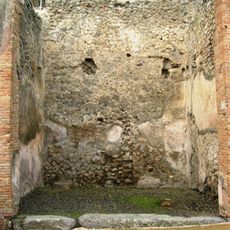
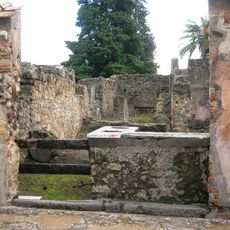
House of the Dioscuri, Roman residential ruins in Pompeii, Italy.
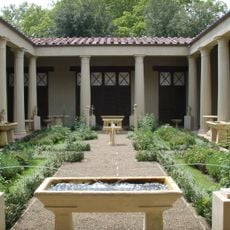
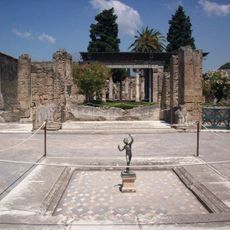
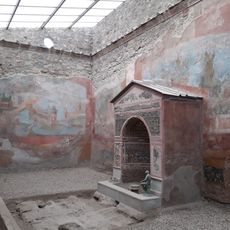
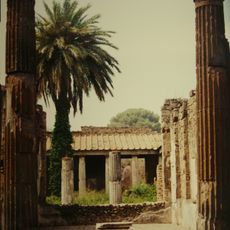
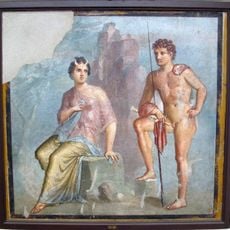
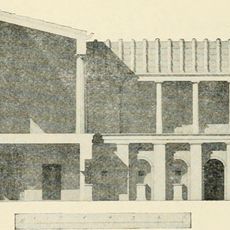
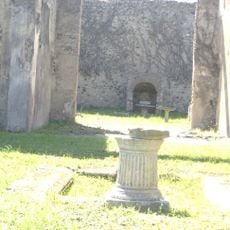
The House of the Dioscuri is a Roman domus in Pompeii formed by merging three houses in the Augustan era. Its Corinthian atrium, one of four in Pompeii, has twelve tufa columns supporting the roof. To the right, a peristyle with a central water basin features Fourth Style panels of architecture and still lifes by the same artist as the House of the Vettii. A tablinum opens to rooms with frescoes of Adonis, Scylla, Apollo and Daphne, and Silenus with the nymph and infant Bacchus.
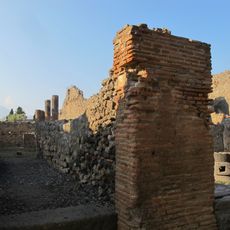
The complex was built in the 1st century AD and was one of the more affluent residences in Pompeii. The eruption of Mount Vesuvius in 79 AD buried the entire city under volcanic ash, preserving these ruins for nearly 2,000 years.
The house takes its name from a painting at the entrance showing the Dioscuri, Castor and Pollux; the work is now kept at the National Archaeological Museum of Naples. The same painter who decorated the House of the Vettii worked on the fourth-style panels of the peristyle, which show architectures and still lifes.
Access to this ancient site is available when visiting the Pompeii archaeological park, with opening times varying by season. It is helpful to wear comfortable shoes and plan your route ahead to explore all areas of the complex.
The name comes from a painting at the entrance showing the Dioscuri, Castor and Pollux; it is now kept at the National Archaeological Museum of Naples. The house also has one of only four Corinthian atria found in Pompeii, with twelve tufa columns supporting the roof.
The community of curious travelers
AroundUs brings together thousands of curated places, local tips, and hidden gems, enriched daily by 92,593 contributors worldwide.