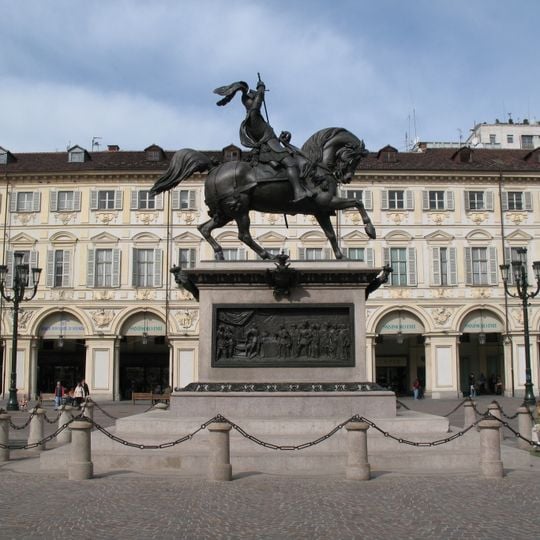
Monument to Emanuele Filiberto, Bronze equestrian statue in Piazza San Carlo, Turin, Italy.
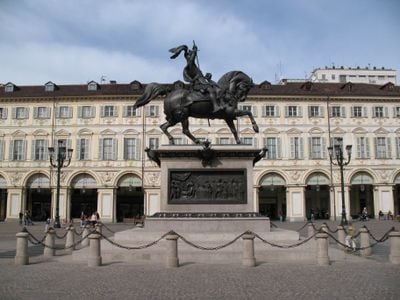
The Monument to Emanuele Filiberto is a bronze equestrian statue by Carlo Marochetti, cast in Paris and placed in Piazza San Carlo in 1838. The duke, in armor and a plumed helmet, raises a baton in his right hand and holds the reins in his left, his cloak flaring behind him. The horse rears with both front legs lifted. The statue stands on a red Baveno granite pedestal with bronze reliefs of the Battle of St. Quentin and the Peace of Cateau-Cambrésis.
King Charles Albert commissioned the monument in October 1831 to celebrate Emmanuel Philibert, Duke of Savoy, and chose Carlo Marochetti to execute it. Cast in Paris, it was shown for two months in the Louvre courtyard before being inaugurated in Piazza San Carlo on 4 November 1838. During the Turin massacre of 21–22 September 1864, bullets struck its base; holes are still visible on the side facing Porta Nuova station. In World War II it was dismantled and taken to Santena, to the park of the Benso di Cavour castle.
Turinese call the monument Caval ëd Bronz, Piedmontese for 'bronze horse', a name in everyday use. The two bronze reliefs on the pedestal show the Battle of San Quintino and the peace of Cateau-Cambrésis. On the evening of 13 October 2007 the restored monument was returned to the city to the notes of Va, pensiero from Verdi's Nabucco.
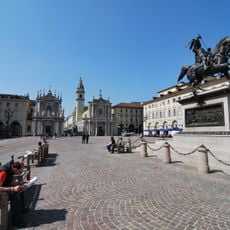
The statue stands at the center of Piazza San Carlo, surrounded by historic buildings and cafes that frame the square. The location is easy to reach and sits in a busy part of the city center.
The pedestal's west relief shows the Battle of Saint-Quentin of 1557, the east one the Peace of Cateau-Cambrésis. On the side facing Porta Nuova station, bullet holes from the 1864 Turin massacre are still visible at the base.
The community of curious travelers
AroundUs brings together thousands of curated places, local tips, and hidden gems, enriched daily by 92,641 contributors worldwide.