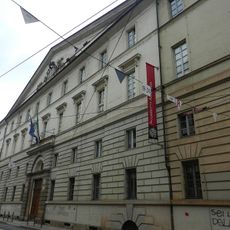
Palazzo Campana, Italian national heritage palace in Turin, Italy.
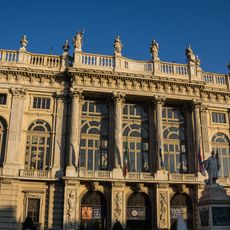
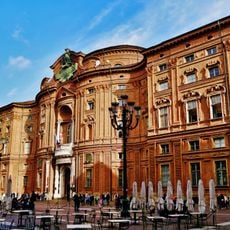
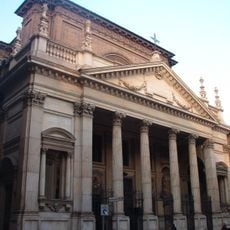
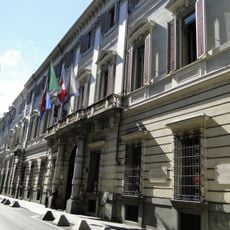
Palazzo Campana sits on Via Carlo Alberto in Turin and combines Baroque and Neoclassical architecture in a spacious building with rich decorations. Inside, the notable Scala delle Forbici staircase designed by architect Filippo Juvarra shapes the experience of moving through the building.
Construction began in 1675 and was completed around the mid-18th century as the seat of the Filippini congregation. Suppressed by the Napoleonic government in 1801, it served as a barracks before returning to the Filippini in 1814. After the order's final suppression in 1855, Alessandro Mazzucchetti remodelled the interiors and it housed the Ministry of Public Works, Turin's central post office and the Officina delle Carte Valori until 1924. From 1929 it was the Casa Littoria of the Fascist provincial federation; on 26 July 1943 it was stormed and partly burned, later holding detention cells for anti-fascists. It is now named after partisan Felice Cordero di Pamparato and houses the mathematics department.
The name Palazzo Campana honours Felice Cordero di Pamparato, a partisan known as "Campana" who was hanged by fascists at Giaveno; after the war the building took his battle name and became a university seat. Since 1967 it has housed mathematics teaching, and today it is the seat of the Giuseppe Peano Department of Mathematics of the University of Turin.
Palazzo Campana at Via Carlo Alberto 10 now houses the Giuseppe Peano Department of Mathematics of the University of Turin, so access follows the department's opening arrangements rather than a museum tour. Enter from Via Carlo Alberto, a short walk from Turin's historic centre and Porta Nuova station.
The name honours Felice Cordero di Pamparato, a partisan hanged by the Fascists at Giaveno; his battle name was Campana. In the basements, cells for anti-Fascist prisoners were built during the Republic of Salò. On 27 November 1967 students led by Guido Viale and Luigi Bobbio occupied the building, then the humanities faculty.
The community of curious travelers
AroundUs brings together thousands of curated places, local tips, and hidden gems, enriched daily by 92,864 contributors worldwide.