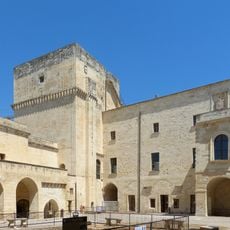
Castello di Acaya, Renaissance castle in Vernole, Italy.
Castello di Acaya is a 16th-century fortress built as a quadrilateral with low, robust bastions at its corners. Two triangular salients face northwest and southeast to deflect gunfire, while two circular rondels stand on the opposite sides. All bastions have gun ports on every level, and a lance-shaped bastion at the southeast corner, with scarps and two tiers of gun ports, first tested grazing defense. An epigraph on the bastion records completion in 1536.
In 1294 Charles II of Anjou granted the settlement of Segine to Gervaso dell'Acaya, whose family held it for three centuries. Alfonso di Acaya built the oldest core of the castle in 1506; his son Giangiacomo enclosed it with walls, bastions and a moat in 1535 and renamed the village Acaya. An inscription on the bastion records completion of the works in 1536. After Giangiacomo died in 1570 the fief passed to the Royal Court, which sold it in 1608 to Alessandro De Montibus, who strengthened the fortress against Turkish raids.
The village was called Segine until 1535, when it took the name of the dell'Acaya family, its feudal lords for three centuries. The castle's name therefore recalls the barons, not only the architect. Coats of arms of the dell'Acaya are carved across the whole complex, and the north-east tower holds a nine-sided hall with carved friezes.
Plan your visit during daylight hours to see both the outer fortifications and interior spaces clearly. The site is walkable on foot and offers good vantage points from different angles around the complex.
Excavations beneath the fortress uncovered a Byzantine church with a fresco from the 14th century depicting a sacred scene. This discovery reveals that the location had religious significance long before the castle was constructed.
The community of curious travelers
AroundUs brings together thousands of curated places, local tips, and hidden gems, enriched daily by 93,528 contributors worldwide.