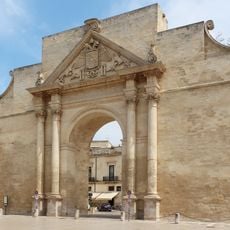
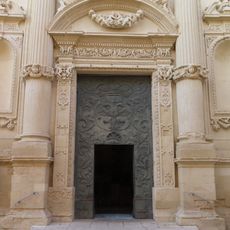
Palazzo dei Celestini, Baroque palace in Lecce, Italy.
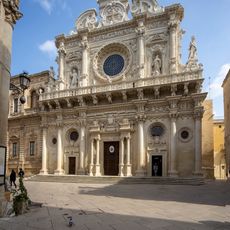
Palazzo dei Celestini is a Baroque palace in Lecce, attached to the Basilica di Santa Croce. Its long facade (1659–1695) was built by Giuseppe Zimbalo and Giuseppe Cino, who designed the first and second orders respectively. The facade is divided vertically by pilasters and has two side loggias, windows with carved frames, and a frieze with heraldic shields. The central portal is decorated with putti and bunches of fruit.
The Celestines settled in Lecce in 1352 under Gualtieri VI of Brienne, count of Lecce and duke of Athens; their first monastery stood where the castle now rises. In 1549 Charles V had it demolished for new fortifications, and the order moved to the present site, where the complex was rebuilt from 1549 on a design by Riccardi. The long facade was raised between 1659 and 1695 by Giuseppe Zimbalo and Giuseppe Cino. Suppressed in 1807, the convent became a government palace and now houses the Prefecture and the Province.
The Celestines settled here in the 16th century, in the Jewish quarter, and built their convent palace in front of the synagogue. The facade's putti and fruit garlands above the portal are typical of the Lecce Baroque, carved in the local soft limestone known as pietra leccese.
The palace stands next to the Basilica di Santa Croce and is easy to locate in Lecce's old town. Since it functions as an administrative building, the exterior is accessible to visitors at any time, though interior access may be limited.
The facade displays the characteristic honey-colored tone of Lecce stone, which shifts its appearance throughout the day as sunlight moves across its surface. This color transformation is especially noticeable during morning and evening hours.
The community of curious travelers
AroundUs brings together thousands of curated places, local tips, and hidden gems, enriched daily by 94,581 contributors worldwide.