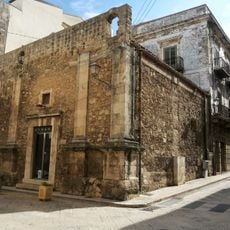
Calatubo Castle, Medieval castle in Alcamo, Italy
Calatubo Castle is an architectural complex about 150 by 35 metres, built on a limestone rock at roughly 152 metres above sea level near Alcamo. Its core is a rectangular structure of 7 by 21.5 metres on the southern part of the rock, reached through three lines of walls, a stepped ramp and an oblong tower.
The fortress was built around 1093 during Norman rule as part of a coastal defense network. It served as a signal station that used light to warn nearby communities of raids coming from the sea.
The name Calatubo is not Arabic: it appears in Latin as castrum Calathatubi in the 1093 document defining the diocese of Mazara. The medieval village that stood around the castle exported cereal and millstones, including water- and wind-mill stones called "Persian mills", quarried near the Finocchio stream, as al-Idrisi recorded in 1154. A local belief holds that underground tunnels link the castle with the Castle of the Counts of Modica and the Ventimiglia tower on Monte Bonifato.
The castle is closed to visitors because it is unsafe, so it can only be seen from outside; the Town Council of Alcamo has often said it wants to recover it. The only practicable access, on the west, is a ramp with large steps leading to the first line of defence, which holds a well and a church hall.
Archaeological remains and caves with signs of earlier habitation have been found around the Norman fortress. These finds show that the site was already occupied long before the castle was ever built.
The community of curious travelers
AroundUs brings together thousands of curated places, local tips, and hidden gems, enriched daily by 94,083 contributors worldwide.