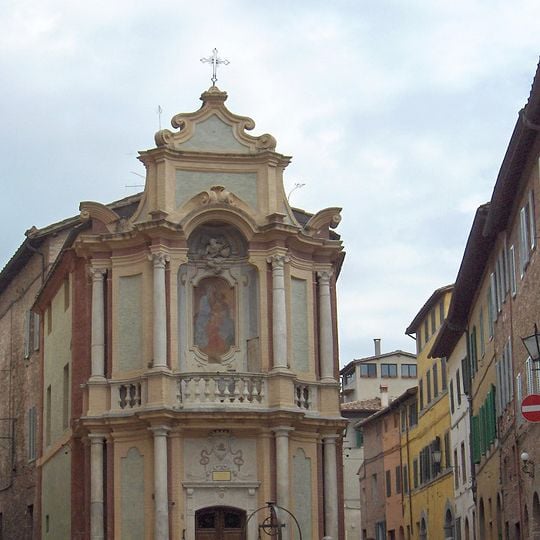
Madonna del Rosario, Former baroque church in Siena, Italy.
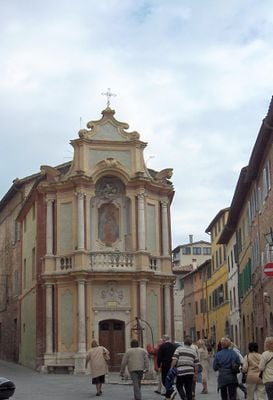
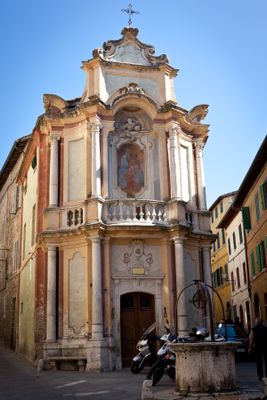
Madonna del Rosario is a deconsecrated chapel wedged between buildings between via San Marco and via della Diana, in the Chiocciola contrada. Its late-baroque facade, concave in plan and built in 1722, has two superimposed orders of pietra serena columns, Doric below and Ionic above, joined by a travertine balustrade. A faded 1725 fresco of the Madonna and Child by Francesco Feliciati sits in the upper order.
The Chiocciola contrada built the chapel between 1655 and 1656, the first in Siena funded by a contrada. A Palio victory paid for its 1722–1725 restoration and late-baroque facade, designed by Pietro Cremoni and probably Jacopo Franchini. Sources disagree on deconsecration: the Italian article gives 1820, the English one 1813, when it became an armory.
The chapel takes its name from the Madonna del Rosario and is also called the Chapel of the Chiocciola after the contrada that built it. The neighbourhood funded its construction in 1655–1656, the first chapel in Siena paid for by a contrada, and in recent years the contradaioli have again used it to shelter the horse during the days of the Palio.
The chapel stands between Via San Marco and Via della Diana, about 200 metres west and uphill from Porta San Marco, in the Chiocciola contrada. It is deconsecrated and not open for services; the interior artworks and devotional activity moved to the nearby Oratory of Santi Pietro e Paolo. In front of the building is a well built in the early 16th century.
The English sources place a primitive fresco of a snail below the repainted Madonna and Child, a mark of the Chiocciola contrada that gave the chapel its nickname. The same sources date the repainted fresco to 1742, while the Italian source gives 1725 and names Francesco Feliciati.
The community of curious travelers
AroundUs brings together thousands of curated places, local tips, and hidden gems, enriched daily by 94,035 contributors worldwide.