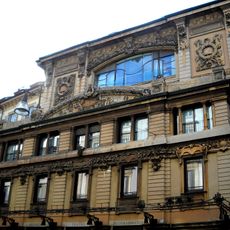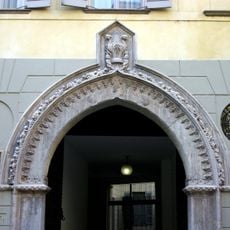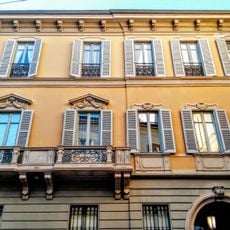
San Tomaso in Terramara Church, Neoclassical church in central Milan, Italy.
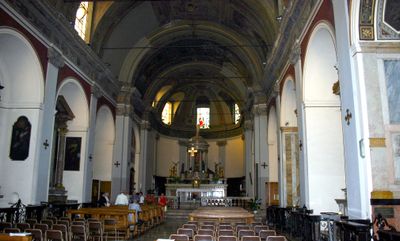
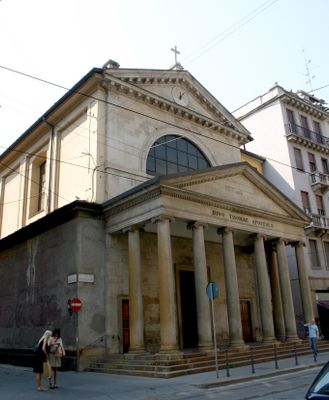
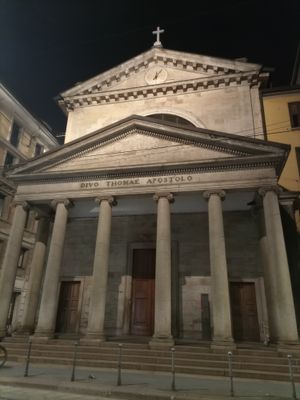
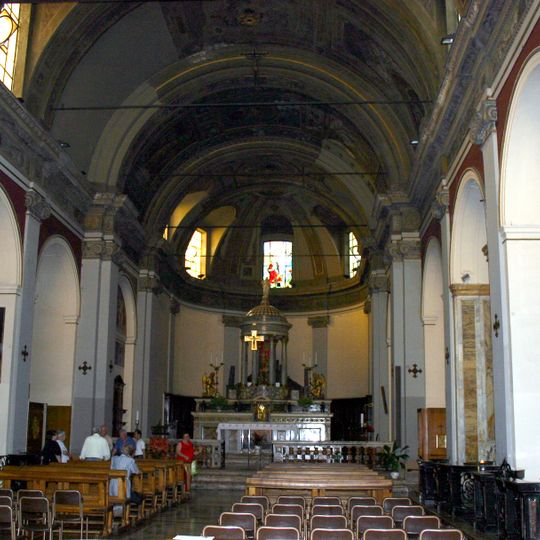
San Tomaso in Terramara is a Neoclassical church in Milan whose facade, built between 1825 and 1827 by Girolamo Arganini, has a hexastyle Ionic portico with a triangular pediment. The pediment partly hides a semicircular window, and the frieze reads "DIVO THOMAE APOSTOLO". Inside, a single nave ends in a semicircular apse with Giuseppe Zanoia's 1779 Neoclassical altar.
San Tomaso in Terramara is documented from the 11th century, when it appears among the parishes of the Porta Comasina district. Carlo Borromeo ordered its rebuilding in 1576. The Neoclassical facade of limestone was built between 1825 and 1827 to a design by Girolamo Arganini, replacing the earlier structure.
The name Terramara probably comes from Terra Amara or Terra Mala, a memory of 11th-century refugees from barbarian invasions. In the first chapel on the right stands a statue of the Virgin crowned by Carlo Borromeo, moved here from San Nazaro in Pietrasanta in a night procession on 15 December 1887.
The church sits in central Milan and is easy to reach on foot. Visitors should be aware that as an active religious site, opening times and religious events may affect when you can visit.
The name has several explanations. The 18th-century historian Giorgio Giulini linked it to a site called Terra mala recorded since the 11th century, while Latuada suggested the church, once a private chapel of the Sigerii family, stood near the place of executions. A Milanese legend instead blames Giovanni Maria Visconti, who had a parish priest buried alive.
The community of curious travelers
AroundUs brings together thousands of curated places, local tips, and hidden gems, enriched daily by 92,883 contributors worldwide.