Palazzo Cagnola, Neoclassical palace in Milan, Italy
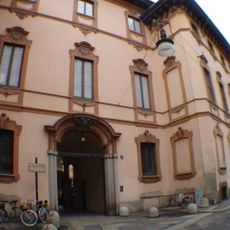
Palazzo Cagnola is a Neoclassical palace on Via Cusani 5, built as a single block from houses bought by Giuseppe Cagnola in 1822. Its main front is divided into nine bays by ten fluted pilasters with Bramante-style capitals, rising from the ground floor across the piano nobile and one upper storey. The ground floor has two doors with balconies above, and the main-floor windows carry small loggias with balustrades; two balconies rest on lion-shaped brackets.
In 1822 the Milanese nobleman Giuseppe Cagnola bought a group of houses at the corner of Via Cusani and Via Rovello, and in 1823 he commissioned the architect Pietro Pestagalli to rebuild them as a single Neoclassical palace. Construction was finished in 1825 under Cagnola's own direction. In 1848 the building housed the Habsburg chancellery and served as Radetzky's headquarters before he fled to the Castello Sforzesco during the Five Days of Milan.
The palace shows how wealthy Milanese families designed their homes in the early 1800s. The symmetrical facade and classical details reflect the taste of an era when Neoclassical style shaped the city.
Palazzo Cagnola stands at Via Cusani 5, a short walk from the Castello Sforzesco and near the Cairoli metro stop. The main front faces Via Cusani, with the entrance corner turning onto Via Rovello. The building is a private property under heritage protection, so visits are generally limited to the facade and the street; arrange any interior access in advance.
The palace is protected by a heritage designation under Italian law 1089 of 1939. Its main facade is divided into nine bays by ten fluted pilasters topped with Bramante-style capitals, rising from the ground floor across the piano nobile and one upper storey.
The community of curious travelers
AroundUs brings together thousands of curated places, local tips, and hidden gems, enriched daily by 95,355 contributors worldwide.