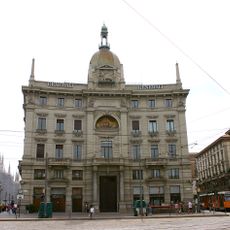
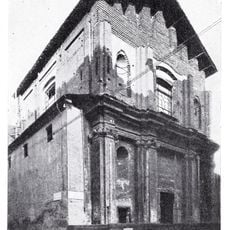
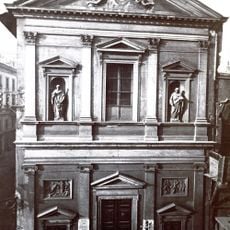
Palazzo Carmagnola, Medieval broletto and palace in Milan, Italy
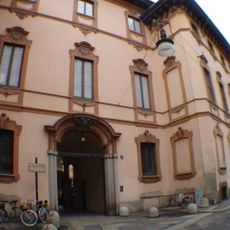
Palazzo Carmagnola is a 15th-century palace at via Rovello 2 in Milan. Of the original building, the porticoes of one courtyard remain, with capitals carved in marble; the six-arched porticoed courtyard dates to a reconstruction of the early 16th century.
Built in the early 15th century by the Visconti as a secondary residence, the palace was given in 1415 by Duke Filippo Maria Visconti to the condottiere Carmagnola, who rebuilt it between 1420 and 1425. In 1465 Genoa swore total submission to Francesco Sforza here. Ludovico il Moro took it by confiscation, and in 1497 it passed to Cecilia Gallerani. From 1786 to 1861 it was Milan's Broletto Nuovissimo, the city hall.
The palace displays architectural details from different periods, with carved capitals and wall paintings that reflect Renaissance artistic work. Visitors can explore these decorative elements throughout the rooms and courtyards, following the layers of artistic history.
The building now houses a theater and various cultural spaces, while offices occupy other areas. Visitors should note that parts of the complex may only be accessible with prior arrangement or during specific times.
The palace's second courtyard holds a sundial drawn into the ground that is attributed to Leonardo da Vinci, who worked on the building's embellishment under Cecilia Gallerani from 1497. Frescoes from the end of the 15th century, linked to Bramante and Leonardo, were brought to light during the most recent restoration.
The community of curious travelers
AroundUs brings together thousands of curated places, local tips, and hidden gems, enriched daily by 94,018 contributors worldwide.