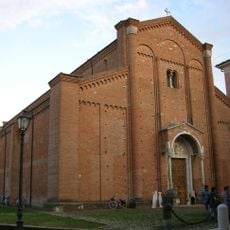
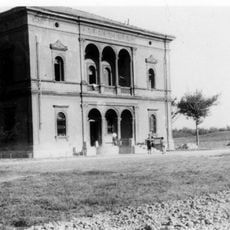
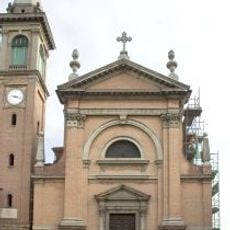
Chiesa di Santa Maria Assunta e Museo Archeologico Simonini, Church and archaeological museum in Castelfranco Emilia, Italy
The Chiesa di Santa Maria Assunta is a brick church on the Via Emilia in Castelfranco Emilia, with a facade redesigned in 1914 by Edoardo Collamarini. Its three naves were added between 1879 and 1887 by Don Luigi Crespellani, who also enlarged the apse. The facade bears verses from the Book of Sirach: "Reginae Caelesti – Quasi rosa plantata super rivos – quasi oliva speciosa in campis".
The church was built between 1226 and 1232, when Pope Gregory IX authorised moving the church of Santa Maria di Ambliano inside the walls of Borgo Franco; it first had a single nave. Cardinal Gabriele Paleotti raised it to archpriesthood and vicariate in 1578. A new building replaced the decayed one from 1692 to 1704, and Don Luigi Crespellani added the two side naves in works of 1879-1887. Edoardo Collamarini redesigned the facade in 1914 and Cardinal Giacomo Biffi consecrated the church on 5 December 1987.
The name Santa Maria Assunta refers to the Assumption of Mary, a key theme reflected in the church's artistic program. Visitors can see how the community expressed its faith through the religious artworks displayed inside.
The building is located in the city center and is accessible on foot, with entry to both the exhibition rooms and the church nave. Group tours are available by request and provide deeper insight into the collections.
The church holds the relics of Saint Prosper, given in 1750 by Pope Benedict XIV to members of the Confraternity of Suffrage who had travelled to Rome on pilgrimage. The second altar on the left nave is dedicated to Saint Domninus, patron of the town; its statue, carved by the Ballanti brothers of Faenza, was donated to the parish in 1841 at the request of archpriest Marco Serrazanetti.
The community of curious travelers
AroundUs brings together thousands of curated places, local tips, and hidden gems, enriched daily by 94,408 contributors worldwide.