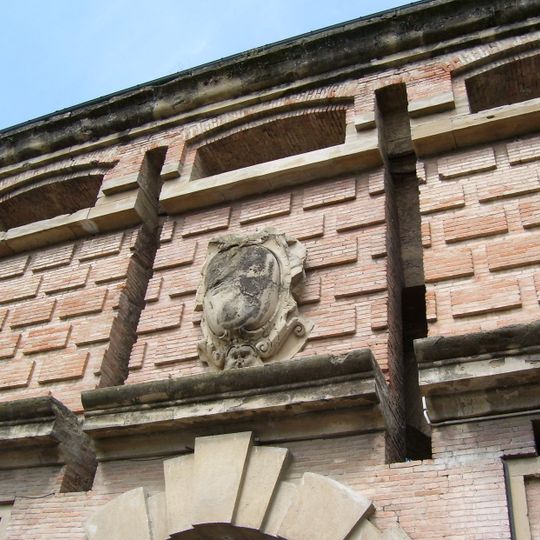
Forte Urbano, Military fortification in Castelfranco Emilia, Italy
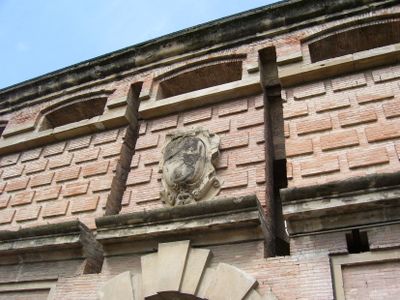
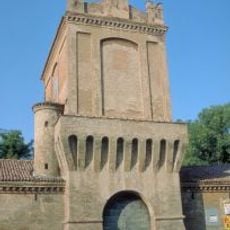
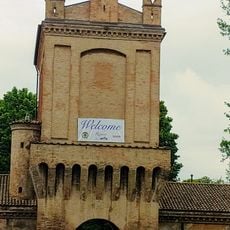
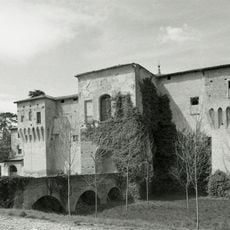
Forte Urbano is a star-shaped fortress at the end of Via Forte Urbano, in the west part of Castelfranco Emilia. Its inner walls are ringed by a wide moat, and four bastions are fitted with small turrets; the outer width reaches 900 metres. Entry was through a large gate with three drawbridges. A model of its bastioned plan is kept in the Museo di Palazzo Poggi.
Pope Urban VIII commissioned the fortress in 1626 to defend the borders of the Papal State; work began in August 1628 under the engineer Giulio Buratti of Senigallia and was nearly finished by 1634. In 1630 the old walls of Castelfranco Emilia were demolished to reuse their material. In spring 1805, after annexation to the Kingdom of Italy, the fort was disarmed, its bastions and southern outer works demolished to restore the straight line of the Via Emilia, and it became a prison.
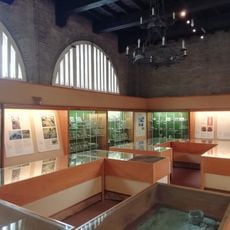
The fort was commissioned by Pope Urban VIII, and its name derives from him. The site had earlier been an Etruscan-Celtic settlement between the 5th and the first half of the 4th century BC; finds from it are kept in the Museo civico archeologico Anton Celeste Simonini in Castelfranco Emilia.
The fortress is most easily reached from the town of Castelfranco Emilia, as it sits on the edge of the settlement. Visitors should wear comfortable shoes, as exploring the four bastions and inner courtyard requires substantial walking.
On the fortress site stood an Etruscan-Celtic settlement between the 5th and the first half of the 4th century BC; its finds are kept in the Museo civico archeologico Anton Celeste Simonini. A model of the bastioned plan is held at the Museo di Palazzo Poggi in Bologna.
The community of curious travelers
AroundUs brings together thousands of curated places, local tips, and hidden gems, enriched daily by 92,764 contributors worldwide.