Santa Maria in Campo, Medieval church in central Florence, Italy
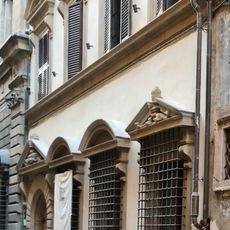
Santa Maria in Campo is a church on a small side square off via del Proconsolo, a short walk from piazza del Duomo. It has a single nave with five chapels, including the high altar, and a plain front facade dating to its 1568 reconsecration. The architrave reads "speciosa in campis".
Santa Maria in Campo was first documented in 1137, when it stood outside Florence's earliest walls along today's via del Proconsolo; it was probably built in the 11th century, before the fifth circle of walls (1173-1175) absorbed the area. In 1220 a dispute between Florence and Bishop Ildebrando of Fiesole over lands alienated by his predecessor Rinieri led Pope Gregory IX in 1228 to assign the church to Fiesole as compensation. Gregory X then had a residence built beside it for the Fiesole bishops, who in 1259 received from Alexander IV the right to hold their curia and diocesan tribunal there. Enlarged in the mid-14th century, it was reconsecrated in 1585.
The architrave reads "speciosa in campis" (beautiful in the fields), a name linked to the open ground outside the old walls; tradition instead ties it to a Marian image found in a nearby field. The church belongs to the Diocese of Fiesole, not Florence, after a 1220 dispute settled by Pope Gregory IX in 1228. Franco Sacchetti set a novella here about an orsa tied to the bell ropes.
The church stands on a small side square off via del Proconsolo, a short walk from piazza del Duomo. It belongs to the diocese of Fiesole, not Florence, so diocesan functions and processions here have been restricted since 1684; processions, when held, are limited to the small square in front. Look for the architrave inscription "speciosa in campis".
The parish was the setting of Franco Sacchetti's 14th-century tale "Le campane di Santa Maria del Campo": pranksters tied the podestà's tame bear to the bell ropes, setting the bells ringing and the neighbourhood shouting "fire". The church also belongs to the diocese of Fiesole, not Florence, a status settled by Pope Gregory IX in 1228.
The community of curious travelers
AroundUs brings together thousands of curated places, local tips, and hidden gems, enriched daily by 94,501 contributors worldwide.