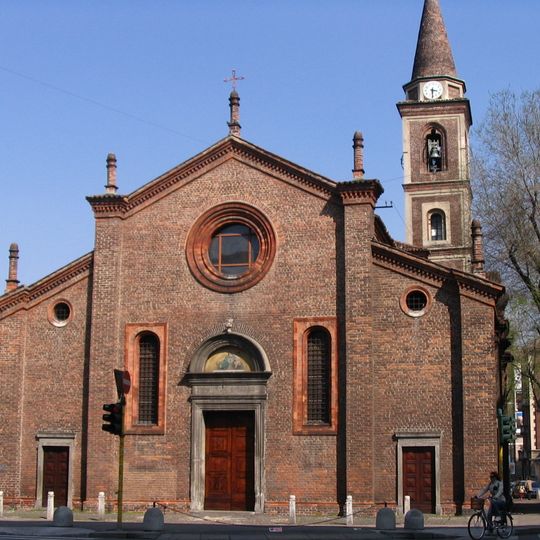
Santa Maria Bianca della Misericordia Church, Church building in Casoretto, Milan, Italy.
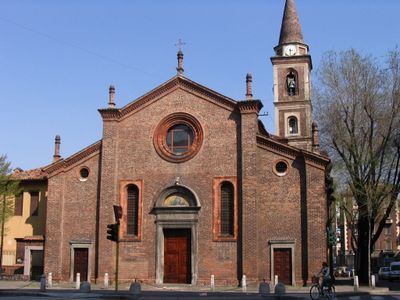
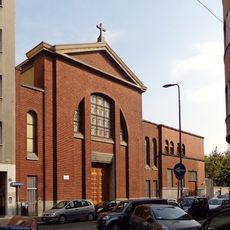
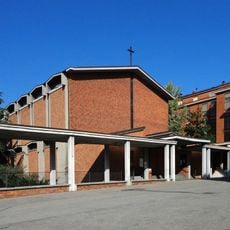
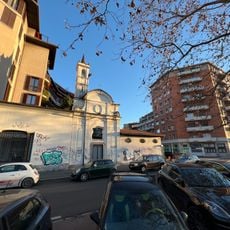
Santa Maria Bianca della Misericordia is a brick church with a facade preceded by a rizzada paving showing a wind rose; to its left stands a cloister recalling Romanesque forms, to the right the bell tower. The interior has three naves, with a fresco of the Vergine Bianca della Misericordia (1446) in the left transept and, in the second arch on the right, a triptych attributed to Bergognone or Ambrogio Bevilacqua with portraits of the Melzi spouses.
A small church existed on the site in 1404, when Pietro Tanzi funded its restoration and brought Lateran canons from Santa Maria della Frigionaia in Lucca; his August 1405 will left all his goods to it on condition that at least six canons reside there. The first prior of the Casoretto congregation was elected on 27 August 1406. Construction of the present church is documented by donations of 1472 and 1477-1479 and was carried out by the Solari, notably Guiniforte Solari; the bell tower was finished on 4 June 1490. It became an abbey in 1566, was suppressed on 17 June 1772, and became a parish church at the start of the 20th century.
The name "Bianca" distinguishes it from two other Marian churches of the same period, Santa Maria Nera at Loreto and Santa Maria Rossa at Crescenzago; the white refers to the Virgin's robe in the fresco inside. The church is also called abbey of Casoretto after the neighbourhood, and in the left transept stands the 1446 fresco of the Vergine Bianca della Misericordia.
The church stands on Piazza San Materno in the Casoretto district, northeast of central Milan. The brick facade faces a rizzada paving that shows a compass rose; the cloister lies to its left and the bell tower, set slightly back, to its right. The cloister, now the courtyard of the oratory, holds numerous tombstones mostly taken from the church.
The church floor contains an inlaid wind rose pattern that draws the eye to the geometry of the space. The adjoining cloister preserves original Romanesque architectural details that contrast with the later style of the main building.
The community of curious travelers
AroundUs brings together thousands of curated places, local tips, and hidden gems, enriched daily by 93,011 contributors worldwide.