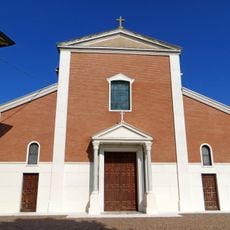
San Bartolomeo, Collegiate church in Busseto, Italy.
San Bartolomeo is a collegiate church on the north-eastern corner of Piazza Giuseppe Verdi in Busseto, built in brick with Gothic and Rococo forms. Its facade is divided by buttresses into three sections, with a large central portal framed by two terracotta cornices attributed to the workshop of Jacopo de Stavolis, and a rose window above. Inside, three naves and ten side chapels are separated by polystyle pillars, with Rococo stuccoes by Fortunato Rusca and Carlo Bossi (1753–1754).
A small church dedicated to San Niccolò stood here in the Middle Ages. In 1336 Marquis Oberto III Pallavicino, having made Busseto the capital of the Pallavicino state, had a larger temple to Saint Bartholomew built, consecrated in September 1340. In 1436 Pope Eugene IV raised it to collegiate church by papal bull, and the following year work began on a Gothic building twice the size, promoted by Marquis Rolando il Magnifico. After the Diocese of Fidenza was created in 1601 it lost many jurisdictional rights.
The first chapel on the right, originally dedicated to Saint Anthony Abbot and now to the Assumption, holds a marble altar from the 19th century with a painting of the Assumption made by Giovanni Evangelista Draghi in 1704. On its walls hang two canvases: the Madonna and Child with Saints Francis and Clare, painted by Camillo Procaccini around 1611, and the Infant Jesus with Saints Bernardino da Siena, Anthony of Padua and Francis of Paola, made by Clemente Ruta between 1734 and 1741.
The church stands at via Roma 123, on the north-eastern corner of piazza Giuseppe Verdi, with the main entrance facing west and the apse to the east. The floor was lowered in 1876 to lengthen the pillars, a job left unfinished to protect the building's stability, so watch your step at the thresholds. Look for the 1584 marble plaque set into the buttress right of the main portal.
A marble plaque of 1584 is set into the buttress right of the main portal, commemorating the 1543 meeting in Busseto between Emperor Charles V and Pope Paul III. The presbytery and apse keep their 15th-century Gothic vaulting, with brick ribs and frescoes of the Passion painted by Giuseppe Moroni in 1942.
The community of curious travelers
AroundUs brings together thousands of curated places, local tips, and hidden gems, enriched daily by 94,652 contributors worldwide.