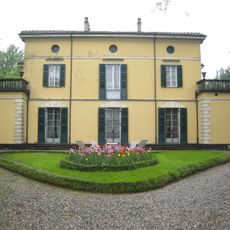
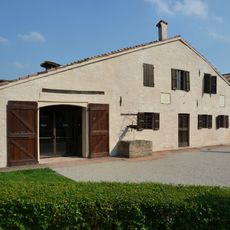
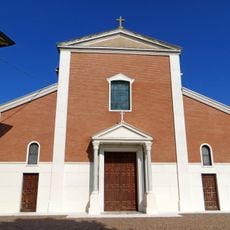
Villa Pallavicino, Renaissance villa in Busseto, Italy
Villa Pallavicino stands on a square artificial island ringed by a fish pond, reached by three small bridges. Its plan is a checkerboard of five square blocks: one open central block and four corner blocks, perfectly symmetrical on every facade. The central block's four entrances open onto a baroque atrium covered by an umbrella vault frescoed in the late 16th century with classical gods, grotesques, putti and fantastic animals.
Matteo Marri, a Busseto condottiero, began building the villa in 1518; its architect is unknown, though Bramante or Vignola has been suggested. Around 1530 the Pallavicino bought it as a summer residence and hosted Emperor Charles V there in 1533. In 1543 it housed the meeting between Pope Paul III and Charles V that led to the Duchy of Parma and Piacenza. Around 1740 Carlo Bossi added Rococo stucco to the facades.
The villa has housed the national Giuseppe Verdi museum since 2009, and the Palazzo delle Scuderie has held the Renata Tebaldi museum since 2014. The name Boffalora comes from the central atrium, built so air passes through from every side, hence "the wind blows".
The residence is open to visitors through guided tours with audio guides available in several languages. These tools provide detailed information as you move through the rooms.
The central hall is called Boffalora ("the wind blows") because its four open entrances let air pass from every direction. Its umbrella vault is covered with late-16th-century frescoes of classical gods, grotesques, putti and fantastic animals, probably by the painter who decorated the Salone degli Stemmi at Torrechiara castle.
The community of curious travelers
AroundUs brings together thousands of curated places, local tips, and hidden gems, enriched daily by 93,816 contributors worldwide.