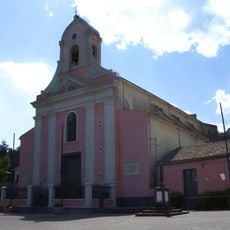
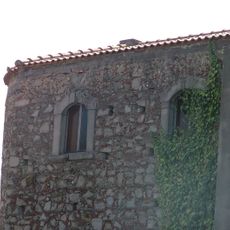
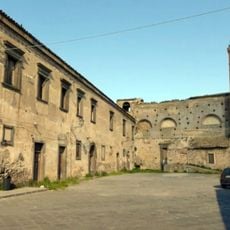
Cuba di Santa Domenica, Byzantine chapel in Castiglione di Sicilia, Italy.
Cuba di Santa Domenica is a rural chapel near Castiglione di Sicilia built on a square, strictly geometric plan: a Latin cross with three naves, a transept and a single apse, all enclosed in cubic forms. Its two-tier facade is tripartite, with two buttresses flanking the central portal. The Romanesque trifora of the upper order alternated lava stone, brick and limestone; its two slender colonnettes are lost, and the left one broke in antiquity, leaving a truncated wall stub.
The chapel was long attributed to the Byzantines and linked to Basilian monasticism, with dates proposed between the 7th and 9th centuries. Study of its building technique, spatial layout and territory now places it between the 10th and 11th centuries, under Islamic and Norman rule. Sebastiano Agati's study of the ruin led to its declaration as a national monument on 31 August 1909.
Locals call the chapel 'a cubula, probably from the medieval Latin cupula, meaning barrel, a name linked to the pseudo-muqarnas vault inside. The vault, resting on a web of sails, precedes or draws on Islamic architecture. The east bifora was oriented so that moonlight entering during the Easter vigil would mark the start of Easter.
The chapel stands in open countryside near the Alcantara river, reached by rural roads from Castiglione di Sicilia. The facade was altered in a 1959 restoration, which gave the central body its present flat appearance. Light enters mainly through the eastern bifora and the two small windows of the transept, so the interior is dim.
Archaeological excavations in the 1990s uncovered skeletal remains near the chapel, pointing to a small medieval cemetery. This finding reveals that the chapel served as the center of a tiny rural community.
The community of curious travelers
AroundUs brings together thousands of curated places, local tips, and hidden gems, enriched daily by 94,351 contributors worldwide.