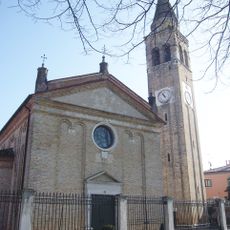
Duomo di San Donà, Neoclassical cathedral in San Donà di Piave, Italy.
The Cathedral of San Donà is a neoclassical building with a single nave topped by a barrel vault divided into twelve sections. Each section features painted depictions of the apostles, while six side chapels along the walls house religious artworks from the 19th and 20th centuries.
The original church was destroyed during World War I, leading architect Giuseppe Torres to design a new structure for the community. Construction took place between 1919 and 1923, resulting in the neoclassical building that stands today.
The church is officially named Santa Maria delle Grazie, though the town is named after Saints Donatus and Hermelius, to whom the earlier Gastaldia church was dedicated. The right-hand plaque beside the main door records the 1476 grant of patronage over that church by Pope Sixtus IV to the Venetian Trevisan family.
The facade faces the street with an eight-column Corinthian portico; the main entrance sits under the pediment crowned by statues of the Madonna, Saint Peter and Saint Paul. Inside, the six side chapels connect to one another, so you can walk from the south chapels to the baptismal chapel on the north side without returning to the nave. The 1924 Mascioni organ stands behind the main altar.
The bell tower was begun in 1854 and finished only in 1902, sixty years after the church was consecrated. At its base the Trevisan family, holders of the Gastaldia rights, had their coat of arms placed. The 1924 Mascioni organ behind the main altar replaced an instrument of the same firm destroyed in the First World War.
The community of curious travelers
AroundUs brings together thousands of curated places, local tips, and hidden gems, enriched daily by 92,954 contributors worldwide.