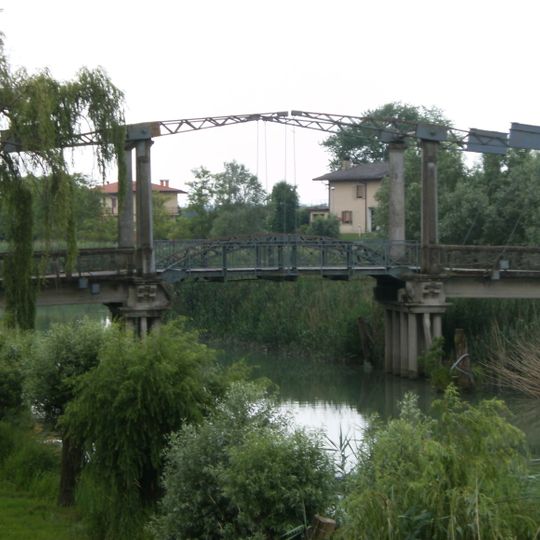
Ponte a bilanciere di Caposile, Counterweight movable bridge in Caposile, Musile di Piave, Italy
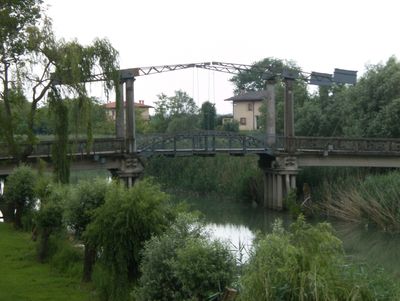
The Ponte a bilanciere di Caposile is a bascule bridge spanning the Old Piave River and connecting the municipalities of San Donà and Musile. Its metal structure features movable central platforms that were historically raised by a counterweight system to allow boats to pass underneath.
Built in 1927, after World War I, the bridge was named after Armando Diaz and stayed in service until 1957, when the current road crossing over the Piave Vecchia opened. It was designed so that river traffic could pass along what was then an important inland navigation route.
The bridge's shape has been compared to the Pont de Langlois, the drawbridge Vincent van Gogh painted several times at Arles in 1888. The comparison rests on the two manually lifted platforms of the central span, which give the structure its balance-beam profile.
The bridge stands at Caposile, where the old Piave meets the Taglio del Sile, on the boundary between San Donà and Musile. It is a disused structure, no longer carrying the road traffic that passed to the newer crossing in 1957. The 2015 conservation work was paid for partly by San Donà and partly by Musile.
The bridge operated with a manual counterweight lifting system that remained functional until 1957, when river traffic ceased. This engineering approach from the 1920s shows how designers balanced the needs of both boat and vehicle traffic.
The community of curious travelers
AroundUs brings together thousands of curated places, local tips, and hidden gems, enriched daily by 93,906 contributors worldwide.