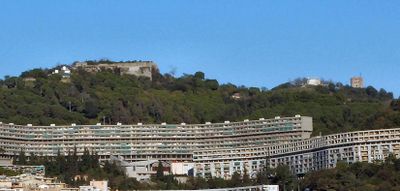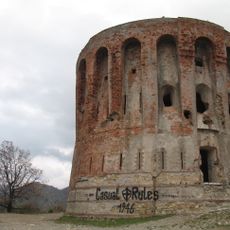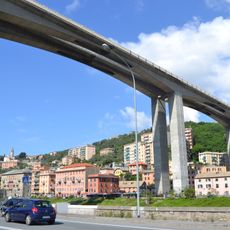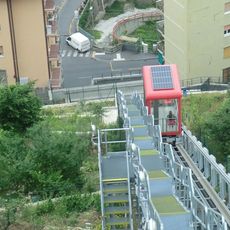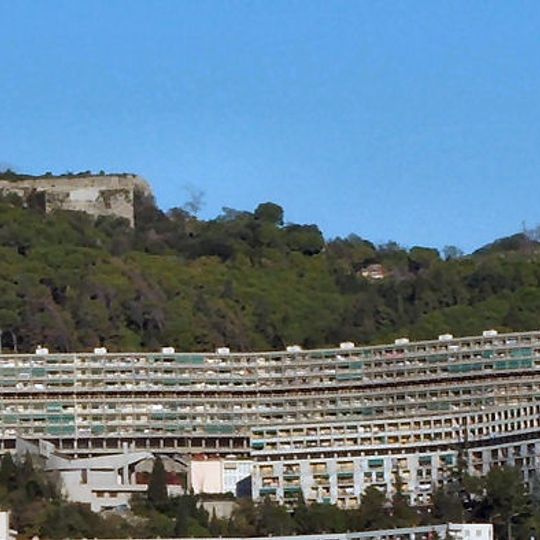
Forte Quezzi, Fort on Colle della Calcinara in Genoa, Italy.
Forte Quezzi stands at 285 m on the summit of Colle della Calcinara, above the Quezzi district and the Bisagno valley. Its main entrance faced the valley, protected by a drawbridge now unrecognizable and topped by a Savoy coat of arms; inside, a staircase led to the inner square, overlooked by a two-story barracks. Today only the perimeter walls of the ground floor remain, filled with earth and debris.
Planned from around 1747 after the Austro-Piedmontese army threatened Genoa, the fort was begun on 27 August under engineer Jacque de Sicre but left unfinished for lack of funds. In 1800 General Andrea Massena ordered work resumed during the siege, and by 1809 French military engineers had rebuilt the bastioned enclosure in stone and added a two-storey barracks. A military report of 1830 judged it in bad condition and recommended no further repairs.
Locals call the hilltop Colle della Calcinara, and the fort's name comes from the Quezzi district below it. Ippolito Nievo set a scene of the 1800 bombardment here in chapter XVIII of Le confessioni d'un italiano, imagining his protagonist Carlino Altoviti witnessing it. Today shepherds use the ruins as shelter for their flocks.
Visiting requires a hike uphill since the fort sits above the city and is not accessible by road. The best time to explore is early morning or late afternoon when visibility is clearest.
In 1857, followers of Mazzini tried to seize the fort by a surprise coup and failed. During the Second World War its first floor was demolished to make room for anti-aircraft artillery, six 76/45 guns defending Genoa. Today collapsed walls remain, and flocks shelter among the ruins.
The community of curious travelers
AroundUs brings together thousands of curated places, local tips, and hidden gems, enriched daily by 93,764 contributors worldwide.