Forte Tombion, Military fort in Valbrenta, Italy
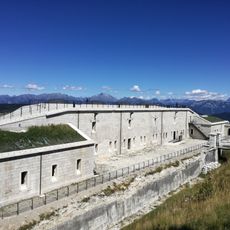
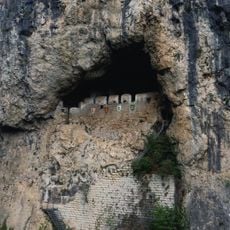
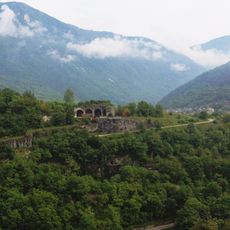
Forte Tombion is a military fort in the Brenta Valley near Valbrenta. It consists of two casemated gun batteries arranged perpendicular to the road and surrounded by protective embankments and a moat.
Forte Tombion was built between 1884 and 1885 as the oldest permanent work of the Brenta-Cismon barrier planned by the Italian Royal Army, on a site where the earlier Covolo di Butistone had guarded the valley. In 1911 it was partly rebuilt to take in the new Trento-Venice railway, with a tunnel closed by armoured doors. By May 1915 the front had moved beyond its guns' range; it briefly mattered during the 1916 Strafexpedition and was used as a military prison for deserters.
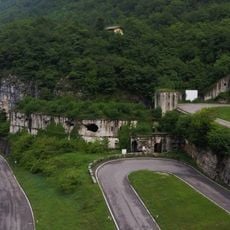
The fort's name comes from the narrow spot called "Tombion" in the Canale di Brenta. The road still passes through the fort between two iron gates with firing slits and small pedestrian doors. The Austro-Hungarian army used it as a dressing station for the Monte Grappa front and renamed it Forte Piovega di Sotto.
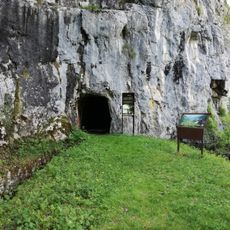
The fort stands in the narrowest point of the Canale di Brenta, about two kilometres north of Cismon del Grappa, right beside the Valsugana state road. The site is on private land and visits must be arranged in advance with the management of the on-site restaurant. The structure is partly demolished and cut by the widened road, so access is limited to the remaining sections.
On the night of 7 June 1944, a patrol of the "Antonio Gramsci" Brigade led by Paride Brunetti, known as "Bruno", took the fort and carried its explosives into the nearby railway tunnel. The blast, including World War I grenades, cut the Bassano del Grappa–Trento line for several days.
The community of curious travelers
AroundUs brings together thousands of curated places, local tips, and hidden gems, enriched daily by 93,972 contributors worldwide.