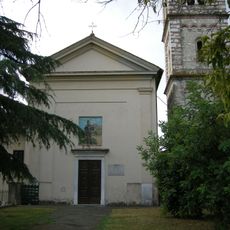
Santa Maria ad Martyres, Augustinian hermitage in Ripafratta, San Giuliano Terme, Italy
Santa Maria ad Martyres, also called Rupecava, is an Augustinian hermitage built around a series of natural caves on the hills of Ripafratta. The single-nave church of Santa Maria stands in ruins, keeping a 1735 altar, a corner of floor mosaic and fragments of 16th-century frescoes; of the two monastic buildings only rubble remains. The first cave, facing the entrance, served as the friars' refectory and later as a grain store.
According to tradition, the hermit William of Maleval built a solitary dwelling on a site of pagan worship; hermits are recorded on Monte Pisano from the 4th century. The hermitage was consecrated in 1214. In 1749 the Augustinian general had the convent suppressed, its assets transferred to San Nicola in Pisa; only Father Luigi Cervelli and a lay brother stayed on. In 1801 the friars of San Nicola sold Rupecava to the Roncioni, and an eremite lived there until the mid-19th century.
The cult of the Madonna di Rupecava, a wooden Virgin and Child dated around 1340 and attributed to Andrea Pisano after its 2000 restoration, spread through the lower Valdiserchio as far as Pisa and Lucca. On 8 September, the Nativity of Mary, several Masses are held at the hermitage. On 14 August the people of Ripafratta keep a vow made after the 1846 earthquake, singing a laude at 13:00, the hour of the tremor.
The complex is reached by paths on the hills of Ripafratta above Molina di Quosa; the church and convent are in ruins and on private land, so access is not guaranteed. The surviving church keeps a 1735 altar, a floor mosaic fragment and traces of 16th-century frescoes. The Madonna di Rupecava, a life-size wooden Virgin and Child dated around 1340 and attributed to Andrea Pisano, is now kept in the pieve of Ripafratta.
The wooden Madonna of Rupecava, a life-size Virgin and Child dated to around 1340 and attributed to Andrea Pisano after a 2000 restoration, was for years covered by bright paint applied by local worshippers hoping to protect it from neglect. It is now kept in the pieve of Ripafratta.
The community of curious travelers
AroundUs brings together thousands of curated places, local tips, and hidden gems, enriched daily by 93,645 contributors worldwide.