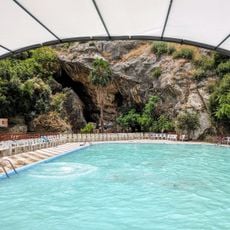
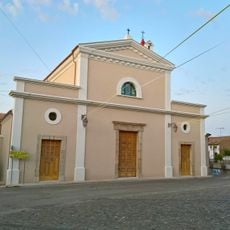
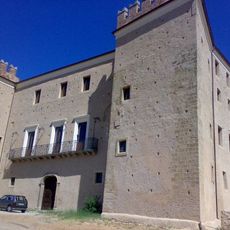
Grotte di Sant'Angelo, Limestone cave in Cassano allo Ionio, Italy.
Grotte di Sant'Angelo is a limestone cave near Cassano allo Ionio featuring underground chambers decorated with stalactites, stalagmites, and mineral deposits. The system extends across multiple levels with natural stone formations visible throughout.
The caves were a stable settlement of Middle Neolithic farming communities (5th–4th millennium BC) until the end of the Bronze Age, and were later frequented in the Metal Ages. In 1951 the speleologist Francesco Orofino first explored the karst cavities at the foot of the Muraglione ridge. Santo Tinè conducted the first stratigraphic excavations between 1962 and 1964, and from 1978 to 1982 the Pavolella cave was excavated, revealing a funerary use with a rare Neolithic cremation.
The caves take their name from Sant'Angelo, and the complex includes the Grotta Pavolella, also called Grotta degli Scheletri (Cave of the Skeletons) because excavations from 1978 to 1982 revealed its funerary use, with a rare Neolithic cremation and painted band pottery. The lower and upper Sant'Angelo caves each extend over a kilometre.
The caves lie at the foot of the rocky relief called Muraglione, right beside the built-up area of Cassano all'Ionio, so they are reached on foot from the town. The complex includes the Grotta Inferiore and Grotta Superiore di Sant'Angelo, each with more than a kilometre of passages, plus the Grotta Pavolella. The ground is gypsum, clay and sand, and the interiors are unlit, so bring a torch and sturdy shoes.
South of the Casa del Drago, rare plants grow without light, fed by water dripping from stalactites. They reach at most 35 cm, almost always touching a stalactite, and can form clusters of over forty specimens, a phenomenon reported to Italy's national speleological community.
The community of curious travelers
AroundUs brings together thousands of curated places, local tips, and hidden gems, enriched daily by 93,690 contributors worldwide.