Oratorio della Grotta, Renaissance oratory in Urbino, Italy
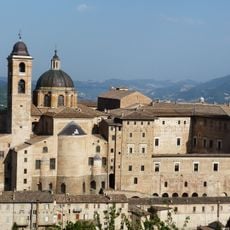
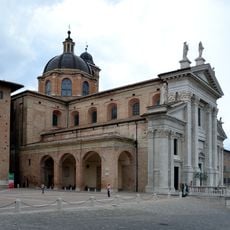
The Oratorio della Grotta, also called Grotte del Duomo, lies beneath Urbino's cathedral: four chapels built between the 16th and 17th centuries open off a long corridor reached by 46 steps from the Loggia del Grano. The main chapel, rebuilt in neoclassical forms by Giuseppe Valadier after the 1789 earthquake, has a barrel vault with stucco symbols of the Passion and five Murano glass chandeliers.
The underground rooms were created in the 1480s during construction of the cathedral, filling the gap between its apse and the hillside; the first two served as storerooms for the stables of the nearby Palazzo Ducale. In the early 16th century Duke Guidobaldo I da Montefeltro granted the first two rooms and Bishop Gabrielli the third to the confraternity founded by father Girolamo Recalchi da Verona, the Compagnia dell'Humiltà, which fitted them out as three chapels and found a 15th-century crucifix held to be miraculous. The entrance was moved to its present site under the Loggia del Grano around the mid-16th century, and in 1655 the confraternity was aggregated to the Arciconfraternita del Santissimo Crocifisso di San Marcello in Rome.
The confraternity that met here staged scenes of the Passion, the Old and New Testaments on Good Friday evenings. Its name came from a 15th-century crucifix found during work on the chapels, held to be miraculous. In 1636 Urban VIII granted the company the privilege of freeing one condemned prisoner each Holy Thursday, alternating with the Confraternity of San Giuseppe.
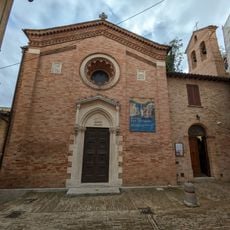
Access is through the Loggia del Grano, not the cathedral portal; forty-six steps lead down to a corridor onto which the four chapels and the Giro del Perdono open. The oratory is open to the public and forms part of the Museo diocesano Albani.
During World War II the oratory sheltered works from the treasury of St Mark's Basilica in Venice, including the Pala d'Oro, hidden from bombing and German looting. The entrance today lies under the Loggia del Grano, whose bay was walled up when the doorway was moved there in the mid-16th century.
The community of curious travelers
AroundUs brings together thousands of curated places, local tips, and hidden gems, enriched daily by 92,985 contributors worldwide.