Lago Gerundo, Ancient lake in Lombardy, Italy
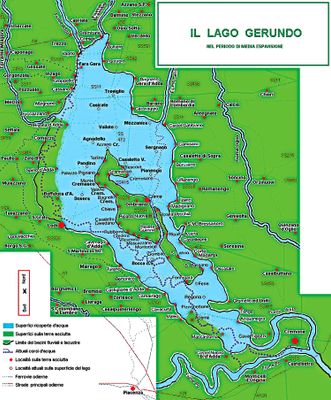
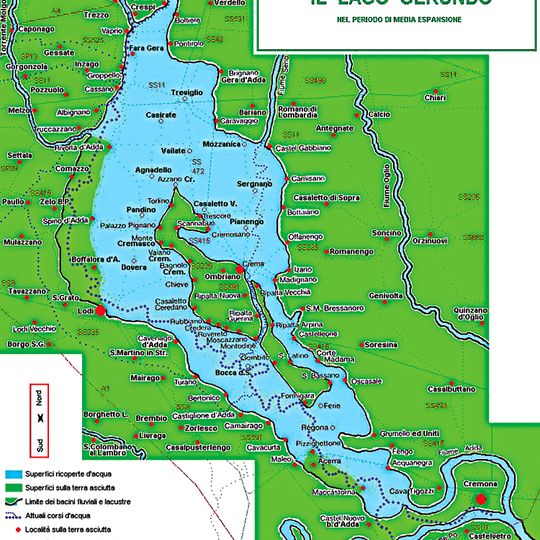
Lago Gerundo was a shallow, unstable expanse of stagnant water straddling the beds of the Adda and Serio rivers, spanning the provinces of Bergamo, Milan, Lodi and Cremona. Its bed was mostly gravel (gerali) covered by only about 45 cm of peat, with the fertile Insula Fulcheria promontory at its centre. A scarp marking its deepest old bed is still visible near the Adda's western bank from Cassano to Castiglione.
Organized drainage of the lake began during Roman times to expand farmland in the fertile plains. The complete draining process took many centuries and was finally finished by the 13th century.
The name likely derives from gera, Lombard for gravel, matching the gerali gravel layers of the area; others link it to the Greek gyrus, for the river meanders. Legend held that the dragon Tarantasio lived in the lake, killing men and children and fouling the air, which was blamed on its breath. The foul smell came from hydrogen sulphide and methane rising from the muddy bottom. A 1563 panel in Lodi commemorated the lake's draining by Saint Christopher.
Nothing of the lake remains, so orient yourself by the scarp that marks its deepest former bed, visible near the western bank of the Adda between Cassano and Castiglione. The land is farmland crossed by drainage canals, among them the Muzza, and the old lake floor is reached by ordinary country roads. The Tormo springs near Arzago d'Adda recall the marshy conditions that once fed the basin.
The lake's name probably comes from géra, the local word for gravel: the bed was mostly gerali, gravel layers covered by only about 45 cm of peat. A scarp marking the old lake's deepest bed is still visible near the western bank of the Adda, from Cassano to Castiglione.
The community of curious travelers
AroundUs brings together thousands of curated places, local tips, and hidden gems, enriched daily by 94,552 contributors worldwide.