Monte Tabor, Hill and national heritage site in Recanati, Italy
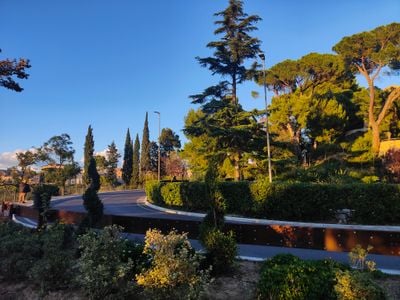
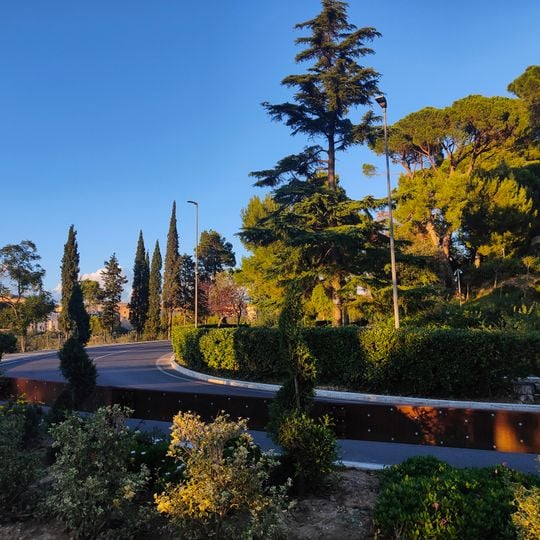
Monte Tabor is the south-facing hill of Recanati, in Marche, covered in dense vegetation with tall conifers along its crest and a trimmed hedge and reddish-brown retaining wall at its base along the road. A path crosses the park beside the Centro Studi Leopardiani and Palazzo Leopardi and reaches the spot where Leopardi probably composed L'infinito, marked by a plaque bearing the verse "Sempre caro mi fu quest'ermo colle".
The hill takes its name from Mount Tabor in Galilee, the hill traditionally identified as the site of the Transfiguration of Jesus. The name ties the Recanati slope to that biblical episode rather than to any event recorded on the spot. Its other name, "Hill of Infinity", comes from Giacomo Leopardi, who set his poem L'infinito here; a plaque on a wall along the park path quotes the opening line, "Sempre caro mi fu quest'ermo colle".
Monte Tabor is tied to Giacomo Leopardi's poem 'L'infinito', which was inspired here and invites people to reflect on infinity and existence. The hill remains a place where visitors come to think about bigger questions, much as Leopardi did centuries ago.
The hill is a park beside the Centro Studi Leopardiani and Palazzo Leopardi; a path crosses it to the spot where Leopardi is thought to have composed L'infinito, marked by a plaque on the wall bearing the line "Sempre caro mi fu quest'ermo colle". The slope is wooded, with conifers along the crest and a trimmed hedge and reddish-brown retaining wall along the road at its base.
A plaque on the wall of the park quotes the opening line of L'infinito: "Sempre caro mi fu quest'ermo colle". The path through the park leads to the spot where Leopardi probably composed the poem, beside the Centro Studi Leopardiani and Palazzo Leopardi.
The community of curious travelers
AroundUs brings together thousands of curated places, local tips, and hidden gems, enriched daily by 93,377 contributors worldwide.