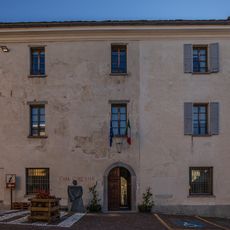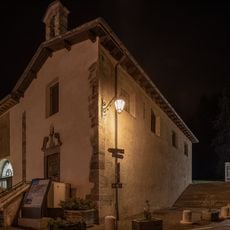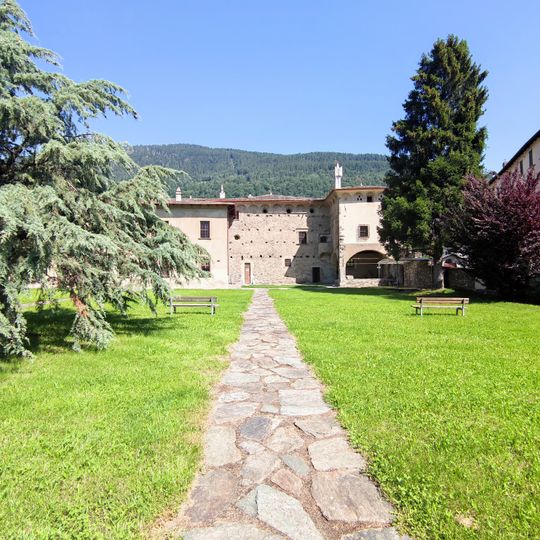
Palazzo Besta, Renaissance palace and museum in Teglio, Italy.
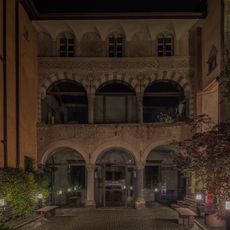
Palazzo Besta is a Renaissance palace in Teglio centered around a rectangular courtyard lined with double loggias that feature arched columns. An octagonal stone well sits in the courtyard's center, while the interior rooms hold painted walls and the Antiquarium Tellinum collection of prehistoric stone objects.
Construction began in 1433 under the Besta family, who may have incorporated elements from an earlier medieval structure on the site. The family became influential merchants and patrons of the arts in the region over the following centuries.
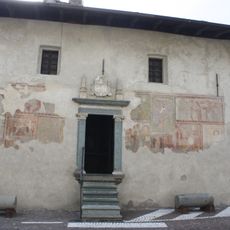
The first-floor halls carry fresco cycles painted between about 1540 and 1630, drawn from Ovid's Metamorphoses, Ariosto's Orlando Furioso and the Bible. Giuseppe Prina painted the Queen of Sheba received by King Solomon. The palace passed from the Besta to the Guicciardi, Quadrio and Parravicini families, and since 2014 it has been run by the state museum service.
The palace sits in Teglio's old town center and is easily reached on foot through the town's narrow streets. Visitors should allow time to explore both the frescoed rooms and the Antiquarium section, as each requires careful attention to appreciate the details.
The Antiquarium Tellinum, housed in the ground-floor guardroom, holds prehistoric stelae from Valtellina; one slab is read as a Mother Goddess figure. The room sits below the frescoed halls, so the palace's oldest objects are found at its lowest level.
The community of curious travelers
AroundUs brings together thousands of curated places, local tips, and hidden gems, enriched daily by 94,672 contributors worldwide.