Palazzo Spinelli di Tarsia, 18th century palace in Naples, Italy
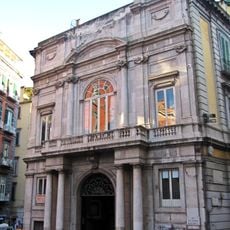
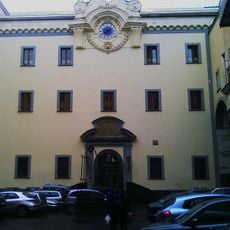
Palazzo Spinelli di Tarsia stands in piazzetta Tarsia, built for Ferdinando Vincenzo Spinelli, prince of Tarsia, to Domenico Antonio Vaccaro's design. A fastoso entrance leads to two pincer-shaped ramps for carriages flanking a central stair; beyond, a first block holds three low wooden arches, then a large rectangular courtyard where the two-storey palace rises.
Ferdinando Vincenzo Spinelli (1685-1753), Prince of Tarsia, commissioned the palace, partly rebuilt from an earlier building documented by Carlo Celano, with the project entrusted to Domenico Antonio Vaccaro. After the Spinelli family died out, a food market was built on the garden grounds between 1841 and 1845 by architect Ludovico Villani for Giuliano de Fazio. The market failed, and from 1856 the Reale Istituto d'Incoraggiamento di Napoli settled there; the palace became a private condominium.
The palace housed the Biblioteca Tarsia, opened to the public by the prince, with a collection of science books and mathematical instruments arranged in a pyramid and adorned with statues by Francesco Pagano. A patronage circle met there, including Maria Angela Ardinghelli and the brothers Berardo and Ferdinando Galiani.
The palace is a private condominium and the former market building on salita Tarsia now houses the Cinema Teatro Bracco, so the courtyard and interiors are not open as a monument. The complex, including an unauthorised car park, has never had a restoration plan since Italian unification. View the facade and the entrance ramps from piazzetta Tarsia.
The garden was meant to evoke the Hanging Gardens of Babylon, but it vanished when a food market was built on its ground between 1841 and 1845 by architect Ludovico Villani. The market failed, and from 1856 the building housed the Reale Istituto d'Incoraggiamento di Napoli.
The community of curious travelers
AroundUs brings together thousands of curated places, local tips, and hidden gems, enriched daily by 93,750 contributors worldwide.