Palazzo dell'Arengo, Medieval palace on Piazza Arringo in Ascoli Piceno, Italy.
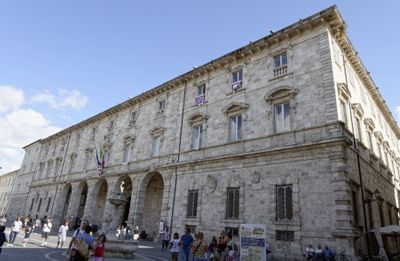
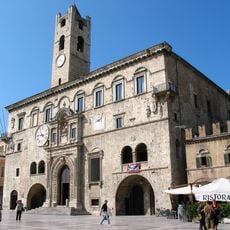
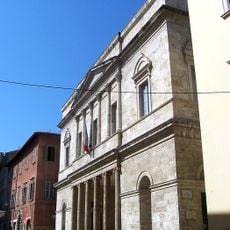
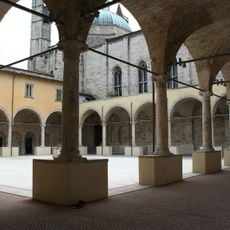
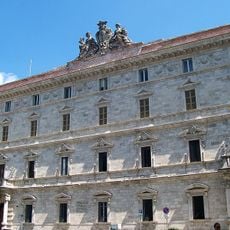
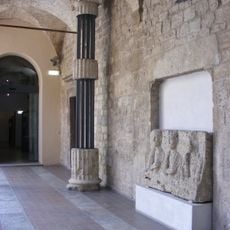
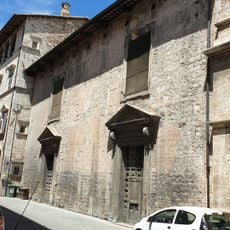
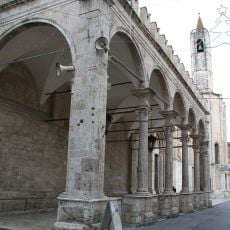
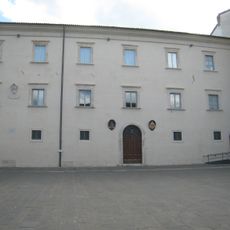
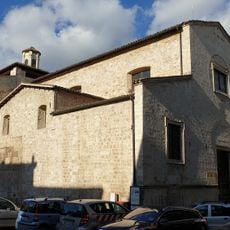
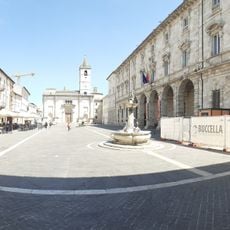
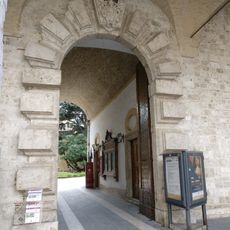
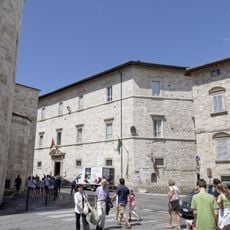
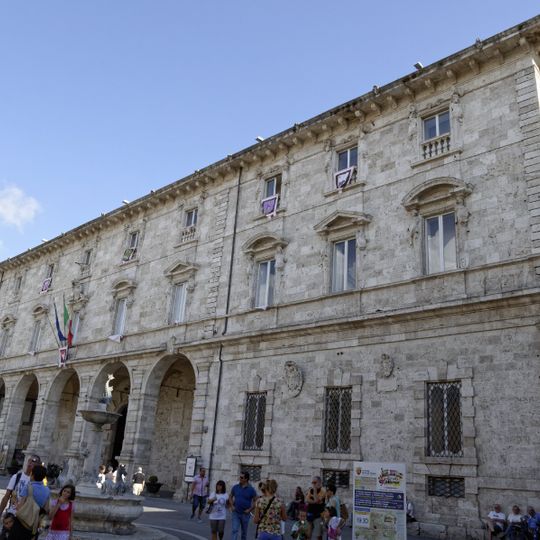
Palazzo dell'Arengo is a palace on Piazza Arringo formed by merging two medieval buildings. Its travertine facade has a central five-arched portico with rusticated pilasters; the first floor has rounded and triangular pediments on female caryatids, the upper floor male atlases with Ionic volutes. The lower portal by Silvio Giosafatti (1658) leads into the 13th-century fondachi hall, a three-nave space of eight bays with cross-vaults on cylindrical columns.
The Palazzo dell'Arengo grew from two separate buildings: the Palazzo del Comune, with its ground-floor arched portico built between the 12th and 14th centuries, and the late-12th-century Arringo. In the 15th century the Apostolic Camera acquired both and installed the papal governor, who resided here until 1564. Giovan Battista Cavagna planned a unifying façade in 1610, but work began only in 1679 under Giuseppe Giosafatti and was completed by his sons Lazzaro and Lorenzo in 1745.
The name references the medieval 'Arengo', a citizen assembly that gathered here to make decisions affecting the city. Walking through the main hall, you can sense how this public space shaped communal life and civic participation.
The palace sits in the heart of the old town at a central square and is straightforward to reach on foot. Multiple levels are open to visitors, allowing you to move through the ground floor and upper sections at your own pace.
The main hall retains its original layout with cross-vaults that once served simultaneously as a courthouse, marketplace, and storage area. This multi-purpose use reveals how medieval buildings brought together different aspects of urban life under one roof.
The community of curious travelers
AroundUs brings together thousands of curated places, local tips, and hidden gems, enriched daily by 92,841 contributors worldwide.