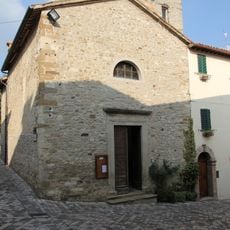
Santa Maria Assunta, Romanesque parish church in San Leo, Italy
Santa Maria Assunta is a three-nave basilica church in San Leo, built of sandstone, limestone and mixed stone blocks. Its three apses carry hanging arches of alternating stone and brick laid three by three between pilasters, and the main apse absorbs about a third of the other two. The facade overhangs the rock below, braced by five buttresses, with side portals under blind loggias.
Tradition credits Saint Leo, a Dalmatian stonecutter, with building the first church here between the 3rd and 4th centuries, dedicated to the Dormitio Virginis. A Carolingian church was damaged by an earthquake and rebuilt almost entirely; the Romanesque features of the present building point to the 11th century. The ciborium in the presbytery bears the date 882 and, by tradition, was dedicated to the Virgin by Duke Orso.
The Sacello di San Leone, entered from an outside door, holds the front of a sarcophagus carved with two peacocks drinking from a vessel; it is the oldest sculpture in the complex, probably earlier than the 8th century, and was reused in the splay of a single-light window. The name of the church recalls the Dormitio Virginis, the Assumption of Mary.
The building is easily accessible from outside and sits on a rocky outcrop with parking nearby. The underground areas require careful entry, so sturdy shoes and possibly a flashlight are helpful additions.
The Sacello di San Leone, entered from an outside door, keeps traces of an apse cut into the rock and the front of a sarcophagus carved with two peacocks drinking from a vessel. This relief, probably older than the 8th century, is the oldest sculpture in the complex and was reused in the splay of a single-light window.
The community of curious travelers
AroundUs brings together thousands of curated places, local tips, and hidden gems, enriched daily by 92,842 contributors worldwide.