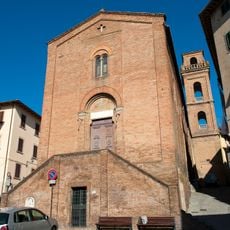
Santa Maria Assunta, Romanesque church in Gambassi Terme, Italy
Santa Maria Assunta is a Romanesque church in Gambassi Terme featuring three naves divided by monolithic columns. The yellow sandstone facade displays horizontal divisions that reflect the interior structure.
Sigeric, Archbishop of Canterbury, travelled the Via Francigena between 990 and 994 and recorded this church as the twentieth stop (mansio) of his return from Rome, calling the place S[an]c[t]e Maria Glan. The church and the village of Chianni belonged to the bishop of Volterra until the 13th century, with disputes involving the Cadolingi counts and San Gimignano. A document of 1210 calls it domus ecclesia, while the present Romanesque complex was rebuilt around 1200.
The name of one master carver survives: Johannes Bundivulus, Latinised in the sources and rendered in Italian as Giovanni Bondi from Volterra. His name is cut into the capital of the second column on the left. The workforce was almost certainly from Volterra, and features of Volterra Cathedral recur here.
The church stands along the Via Francigena in the hamlet of Chianni, a short distance from Gambassi Terme. Since 2009 the adjoining buildings have been renovated to house a hostel for pilgrims, useful for those walking the route. The interior is entered from the yellow sandstone facade; the three naves and transept are visible at a glance.
Archaeological work in 1957 uncovered remains of the original Romanesque apse during structural reinforcement operations. This discovery helped reveal the building's original architecture and construction methods.
The community of curious travelers
AroundUs brings together thousands of curated places, local tips, and hidden gems, enriched daily by 94,359 contributors worldwide.