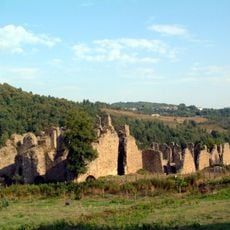
Reventino, Mountain summit in Catanzaro Province, Italy
Reventino is a mountain summit in Catanzaro Province, Calabria, sitting at the narrowest point of the Italian peninsula between the Ionian and Tyrrhenian seas. The terrain rises sharply from the surrounding valleys, and the peak reaches about 1,417 meters (4,649 feet) above sea level.
Reventino's rocks are little like those of the Apennines and resemble instead those of the Alps, Corsica and Sardinia; geologist Walter Álvarez read the westward distortion of decimetre-scale folds in its greenstone as evidence that the massif detached from the Alps and was carried passively to its present position. Until the 15th century the massif was nearly uninhabited. From the late Middle Ages its land belonged to the Cistercian abbey of Corazzo and the Diocese of Martirano, while people from the villages below held grazing, wood-gathering and snow-collecting rights there.
The mountain's name appears in local Calabrian as Rivintinu, Ruventinu or Riventinu. Until the 15th century the massif was largely uninhabited; from the late Middle Ages the land belonged to the Cistercian abbey of Corazzo and the Diocese of Martirano, while people from Motta Santa Lucia, Martirano and Scigliano held customary rights of grazing, wood-gathering and snow collection. Colonists came up in spring for farming and returned down in autumn.
Several trails lead to the summit, with the most accessible starting points near the villages of Platania and Decollatura on opposite sides of the mountain. Snow can cover the upper paths in winter, so the best time to go is from late spring through early autumn.
On a clear day, it is possible to see both the Ionian and the Tyrrhenian seas from the top at the same time, something that very few points on the Italian mainland allow. The peninsula is so narrow at this latitude that the two coastlines are only a short distance apart.
The community of curious travelers
AroundUs brings together thousands of curated places, local tips, and hidden gems, enriched daily by 94,308 contributors worldwide.